



Compare locomotives
Add a locomotive
Liverpool & Manchester No. 1 “Rocket”
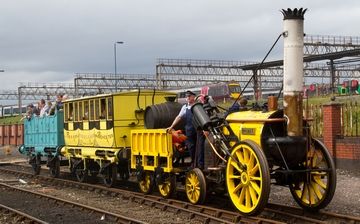
One of the most significant locomotives of all times was the „Rocket”, built in 1829 by George and Robert Stephenson for the Rainhill Trials which were held by the Liverpool & Manchester Railway. In these trials, the ...
| Liverpool & Manchester No. 1 “Rocket”Remove | |
|---|---|
| Variant | Standard |
| Built | 1829 |
| Manufacturers | Robert Stephenson & Co. |
| Wheel arrangement | |
| Gauge | 1435 mm |
| Length | |
| Service mass | 4320 kg |
| Top speed | 48 km/h |
| Power | |
| Engine |
General
| Property | Liverpool & Manchester No. 1 “Rocket” Standard Remove |
|---|---|
| Built | 1829 |
| Manufacturers | Robert Stephenson & Co. |
| Wheel arrangement | 0-2-2 (Northumbrian) |
| Gauge | 1,435 mm |
Dimensions and weights
| Property | Liverpool & Manchester No. 1 “Rocket” Standard Remove |
|---|---|
| Wheelbase | 2.16 m |
| Service mass | 4.3 t |
| Adhesion mass | 2.7 t |
| Total mass | 7.6 t |
| Rigid wheelbase | 2.16 m |
| Axle load | 2.7 t |
Boiler
| Property | Liverpool & Manchester No. 1 “Rocket” Standard Remove |
|---|---|
| Grate area | 0.557 m² |
| Firebox surface | 1.858 m² |
| Tube heating surface | 12.821 m² |
| Evaporative heating surface | 14.679 m² |
| Total heating surface | 14.7 m² |
Power plant
| Property | Liverpool & Manchester No. 1 “Rocket” Standard Remove |
|---|---|
| Driver diameter | 1,435 mm |
| Boiler pressure | 3.4 bar |
| Expansion type | simple expansion |
| Cylinders | two, 203 x 432 mm |
Power
| Property | Liverpool & Manchester No. 1 “Rocket” Standard Remove |
|---|---|
| Power source | steam |
| Indicated power | 15 kW (20 PS) |
| Top speed | 48 km/h |
| Starting effort | 3.6 kN |
Calculated values
| Property | Liverpool & Manchester No. 1 “Rocket” Standard Remove |
|---|---|
| Factor of adhesion | 1 : 7.28 |
| Optimal speed | 26 km/h |
| Power-to-weight ratio | 3.5 kW/t |
| Heating Surface Equivalent | 24.0 m² |
| Cylinder volume/HSE | 1 : 1,168.42 |
| Adhesive weight/Total | 1 : 1.60 |
| Tractive force/Heating surface | 1 : 5.18 |
| Grate area/Heating surface | 1 : 26.35 |
| Firebox/Tube surface | 1 : 6.90 |