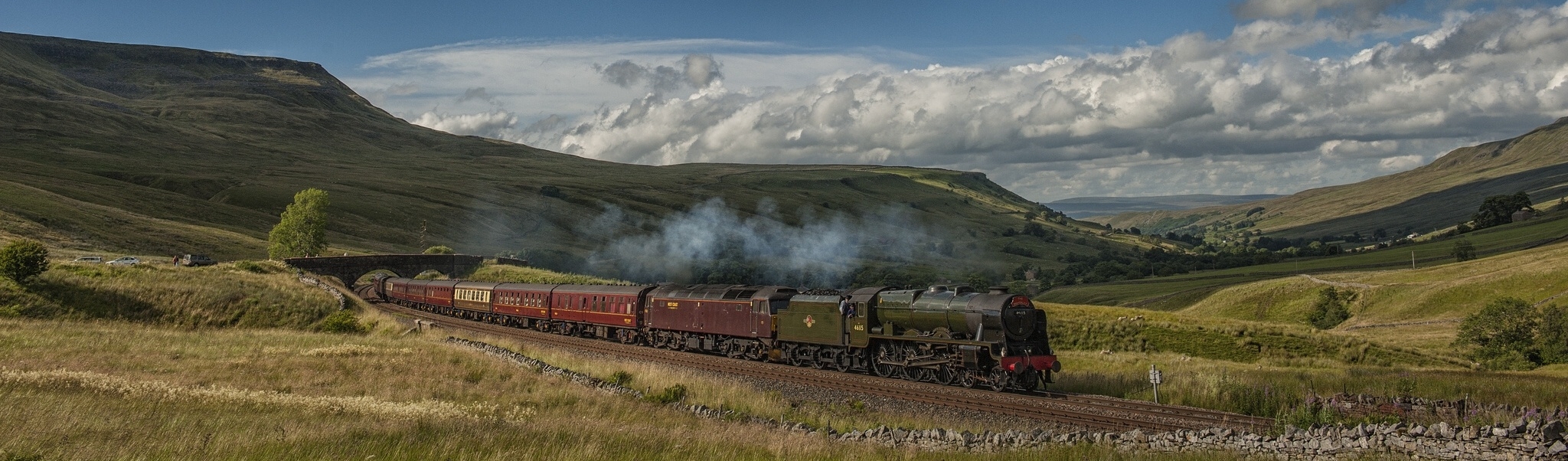



London, Brighton & South Coast class I1
The I1 was built in two batches of ten locomotives each in 1906 and 1907 for the suburban lines in south London. They had a 4-4-2T wheel arrangement with a five foot six inch driving wheel diameter and a condensing apparatus for use in urban environments. In the second batch, the driving wheels and coupling rods of the class D1 were used, what shortened the wheelbase.
Occasionally they were also used as far as Brighton or hauled the royal train. However, they were bad steamers on suburban lines with short distances between stations. After being taken over by the Southern Railway, between 1925 and 1932 they received new superheated boilers left over from the rebuild of the classes I3 and B4. Now performing better only two were retired before 1948 and the the last ones of the remainder were used by British Railways until 1951.
Technical data
General
- Built
- 1906-1907
- Manufacturers
- Brighton
- Wheel arrangement
- 4-4-2T (Atlantic)
- Gauge
- 1,435 mm (Standard gauge)
Dimensions and weights
- Wheelbase
- 8.83 m
- Service mass
- 69.4 t
- Adhesion mass
- 37.2 t
- Rigid wheelbase
- 2.67 m
- Axle load
- 18.6 t
- Water capacity
- 9,013 l
- Fuel capacity
- 3.3 t (coal)
Boiler
- Grate area
- 1.619 m²
- Firebox surface
- 8.663 m²
- Tube heating surface
- 88.038 m²
- Evaporative heating surface
- 96.701 m²
- Total heating surface
- 96.7 m²
Power plant
- Driver diameter
- 1,676 mm
- Boiler pressure
- 11.7 bar
- Expansion type
- simple expansion
- Cylinders
- two, 444 x 660 mm
Power
- Power source
- steam
- Estimated power
- 447 kW (608 PS)
- Starting effort
- 77.5 kN
Calculated values
- Factor of adhesion
- 1 : 4.70
- Optimal speed
- 35 km/h
- Power-to-weight ratio
- 6.4 kW/t
- Heating Surface Equivalent
- 140.0 m²
- Cylinder volume/HSE
- 1 : 1,463.84
- Adhesive weight/Total
- 1 : 1.87
- Tractive force/Heating surface
- 1 : 16.75
- Grate area/Heating surface
- 1 : 59.73
- Firebox/Tube surface
- 1 : 10.16