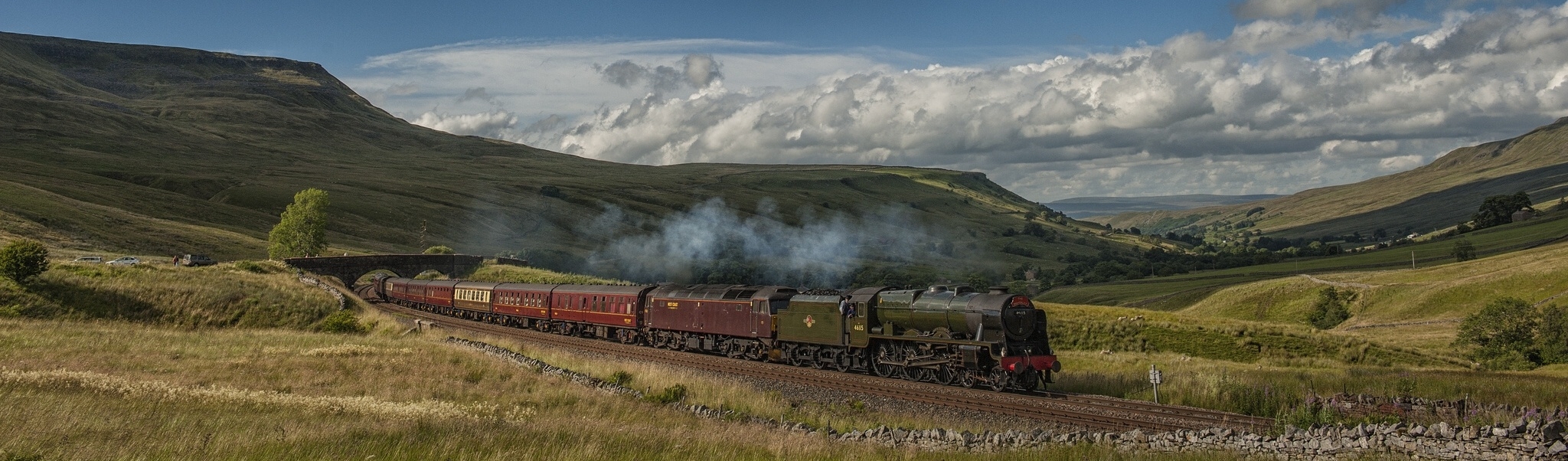



Saxon XII H2
German Reichsbahn class 382-3, Czechoslovak State Railways class 365.5, and Polish State Railways Ok2
A few years after the turn of the century, an express locomotive with a 4-6-0 wheel arrangement was procured in the form of class XII H and its subtypes. The highest number of these reached the XII HV, but it was too complex with its four-cylinder compound engine. Then they developed the XII H2, which was equipped with a simple two-cylinder engine. It was also known by the nickname “Sächsischer Rollwagen” (“Saxon trolley”).
The basic structure of the XII H2 was very similar to the heavier Prussian P 8, but due to the more modern technology and the higher boiler pressure, it could show a greater indicated power. Since the locomotives were intended for the more mountainous routes of the Saxon network, a smaller diameter was chosen for the driving wheels and a maximum speed of only 90 km/h was accepted in order to be able to use a higher tractive force instead.
For the time being, a total of 149 were procured in the period from 1917 to 1922. Ten units were lost during the First World War and after the war 15 units had to be handed over to France, so that the Reichsbahn was able to take over 124 locomotives. Like the P 8, they were assigned to the class 38 and were given the numbers 38 201 to 38 324. Since the Reichsbahn needed further XII H2s, ten new examples were built in 1927. In 1938, a large part of the locomotives were relocated to the Sudetenland, which was now part of the German Reich. This was the reason that after the Second World War about half of the stock was found on the territory of Czechoslovakia. These 61 now belonged to the ČSD and were used until 1959 as class 365.5. In Germany, most of the locomotives came to the Soviet occupation zone, where they were last based in Brandenburg on the Reichsbahn of the GDR and disappeared by 1971.
Technical data
General
- Built
- 1917-1922, 1927
- Manufacturers
- Hartmann
- Wheel arrangement
- 4-6-0 (Ten-wheeler)
- Gauge
- 1,435 mm (Standard gauge)
Dimensions and weights
- Length
- 18.97 m
- Wheelbase
- 7.20 m
- Empty mass
- 62.3 t
- Service mass
- 69.4 t
- Adhesion mass
- 46.5 t
- Total mass
- 109.9 t
- Rigid wheelbase
- 3.50 m
- Axle load
- 15.6 t
- Water capacity
- 21,000 l
- Fuel capacity
- 7 t (coal)
Boiler
- Grate area
- 2.83 m²
- Firebox surface
- 13.47 m²
- Tube heating surface
- 146.45 m²
- Evaporative heating surface
- 159.92 m²
- Superheater surface
- 43.2 m²
- Total heating surface
- 203.1 m²
Power plant
- Driver diameter
- 1,570 mm
- Boiler pressure
- 13 bar
- Expansion type
- simple expansion
- Cylinders
- two, 550 x 600 mm
Power
- Power source
- steam
- Indicated power
- 971 kW (1,320 PS)
- Top speed
- 90 km/h
- Starting effort
- 127.7 kN
Calculated values
- Factor of adhesion
- 1 : 3.57
- Optimal speed
- 47 km/h
- Power-to-weight ratio
- 14.0 kW/t
- Heating Surface Equivalent
- 313.7 m²
- Cylinder volume/HSE
- 1 : 908.92
- Adhesive weight/Total
- 1 : 1.49
- Tractive force/Heating surface
- 1 : 13.14
- Grate area/Heating surface
- 1 : 71.77
- Firebox/Tube surface
- 1 : 10.87
- Total/Superheater
- 1 : 3.70