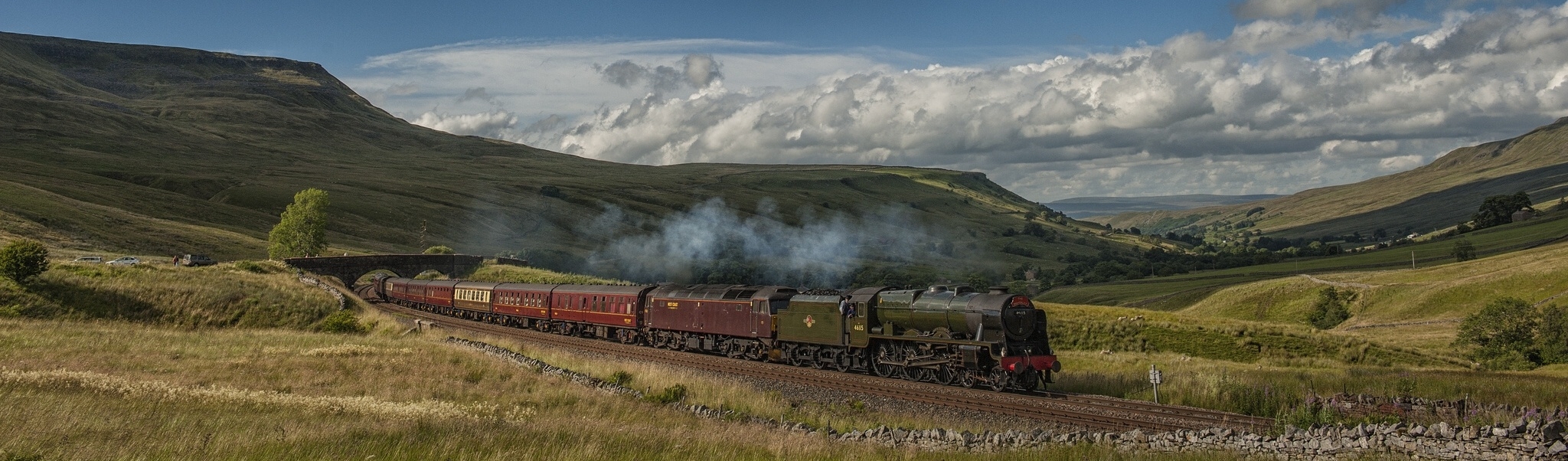



Bern-Lötschberg-Simplon Railway Fb 5/7
Bern-Lötschberg-Simplon Railway Be 5/7

After the tests with the two electric locomotives on the Spiez-Frutigen route, conclusions were drawn from the experience as to what a new, series-built locomotive should look like. The F 2x3/3 impressed with its power train, while the Fb 2x2/3 with its carrying axles improved running smoothness and the ability to negotiate curves. That is why the decision was made to order a similar power train from the manufacturers of the F 2x3/3 locomotives, but instead of bogies they were equipped with coupled axles fixed in the frame and a carrying axle at each end. Additional electrical assemblies were supplied by BBC to shorten delivery times. A total of 13 locomotives were delivered in 1913, which were to pull both freight and passenger trains on the newly built mountain route, including the 14.6 km long Lötschberg tunnel.
In order to achieve good running characteristics, three of the five driven axles could be moved sideways. While the middle one could be moved by 25 mm, the first and fifth were each mounted with the adjacent carrying axle in a Krauss-Helmholtz bogie. With the lateral deflection of the carrying axles by a maximum of 78 mm, they were moved by up to 40 mm. Despite the five driven axles, this made a fixed wheelbase of just 4,500 mm possible.
Between the second and third, as well as between the third and fourth coupled axles, there was a 14-tonne series motor on the frame, which drove a jackshaft via a Citroën gearbox underneath. By means of a rod triangle on each side, both engines acted on the middle axle. Since the rod triangles often broke under the high load during operation, they were later replaced with cast pieces. In order to achieve a large number of speed steps with a relatively small number of taps on the transformers, the next of the twelve steps of only one of the motors was switched alternately to obtain a total of 24 steps.
With an hourly output of 2,500 hp, the Fb 5/7, which was soon renamed the Be 5/7, was the most powerful electric locomotive in the world. On the ramp with a gradient of 2.7 percent, it was able to pull trains weighing 330 tonnes at 50 km/h. After the predecessor locomotive had been moved to flatter routes, the Be 5/7 was the only locomotive used on this route. Thanks to the good running characteristics, the locomotives were later approved for 80 instead of 75 km/h, one locomotive was even equipped with four smaller motors and could run 90 km/h. From the second half of the 1940s, they were increasingly pushed into freight train service b the Ae 4/4 and when the Re 4/4 were delivered in 1964, they were quickly scrapped.
Technical data
General
- Built
- 1913
- Manufacturers
- mechanical part: SLM, electrical part: Oerlikon, BBC
- Wheel arrangement
- 1-E-1
- Gauge
- 1,435 mm (Standard gauge)
Dimensions and weights
- Length
- 16.00 m
- Wheelbase
- 11.34 m
- Service mass
- 107 t
- Adhesion mass
- 78.2 t
- Rigid wheelbase
- 4.50 m
- Axle load
- 16.6 t
Power
- Power source
- electric - AC
- Continuous power
- 1,840 kW (2,502 PS)
- Top speed
- 80 km/h
- Starting effort
- 176.5 kN
Calculated values
- Factor of adhesion
- 1 : 4.35
- Power-to-weight ratio
- 17.2 kW/t
- Adhesive weight/Total
- 1 : 1.37