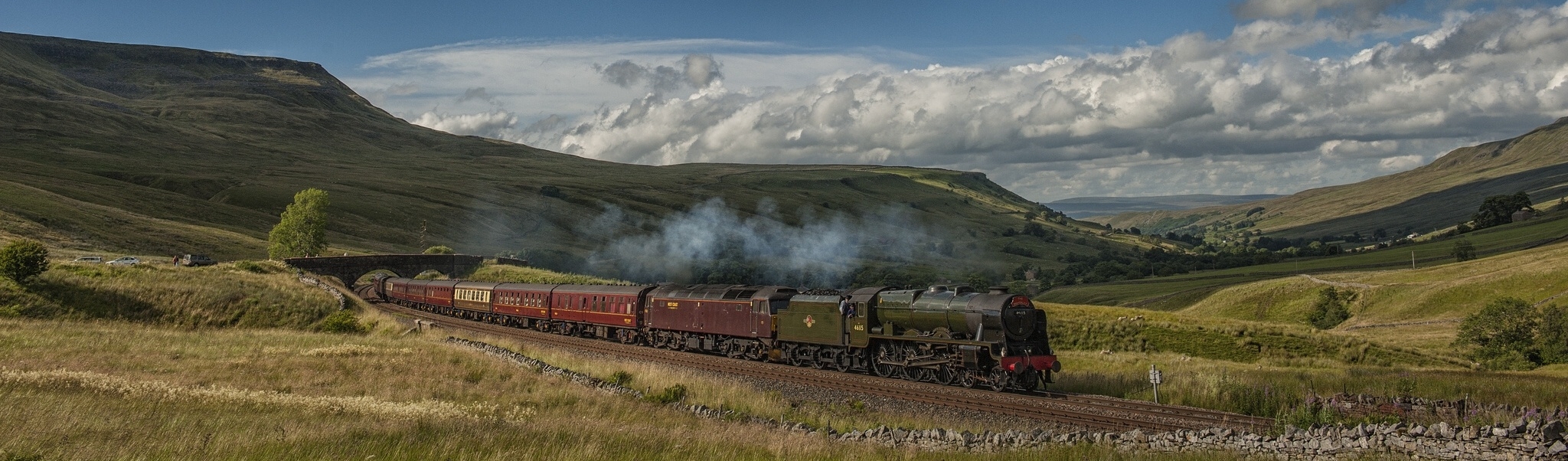



Mexicano class R-3
The last and heaviest Double Fairlies ordered by the Mexican Railway were the three members of the class R-3, numbered 183 to 185, which were built by Vulcan Foundry in 1911. They were ordered for the Orizabo-Esperanza line and had to haul 300 tons on inclines of 1 in 25, while negotiating curves of five chains (100 metres). To achieve the desired power, they weighed 138 tons with an axle load of 23 tons. This made them the heaviest and most powerful Double Fairlies ever built.
Despite their British builder, they had a typical American appearance. The water tanks above the boiler had a total capacity of 4,800 imperial gallons and made the complete locomotives look very bulky. This was further increased when they were converted to burn oil, with the oil tanks above the water tanks. Their careers ended in 1923 after the line had been electrified.
Technical data
General
- Built
- 1911
- Manufacturers
- Vulcan Foundry
- Wheel arrangement
- 0-6-6-0T (Double Fairlie)
- Gauge
- 1,435 mm (Standard gauge)
Dimensions and weights
- Length
- 17.11 m
- Wheelbase
- 10.82 m
- Service mass
- 140.2 t
- Adhesion mass
- 140.2 t
- Rigid wheelbase
- 2.82 m
- Axle load
- 23.4 t
- Water capacity
- 21,823 l
- Fuel capacity
- 8.1 t (coal)
Boiler
- Grate area
- 4.436 m²
- Firebox surface
- 22.761 m²
- Tube heating surface
- 248.887 m²
- Evaporative heating surface
- 271.649 m²
- Total heating surface
- 271.6 m²
Power plant
- Driver diameter
- 1,219 mm
- Boiler pressure
- 12.8 bar
- Expansion type
- simple expansion
- Cylinders
- four, 483 x 635 mm
Power
- Power source
- steam
- Estimated power
- 1,119 kW (1,521 PS)
- Starting effort
- 263.0 kN
Calculated values
- Factor of adhesion
- 1 : 5.23
- Optimal speed
- 26 km/h
- Power-to-weight ratio
- 8.0 kW/t
- Heating Surface Equivalent
- 385.5 m²
- Cylinder volume/HSE
- 1 : 1,205.39
- Adhesive weight/Total
- 1 : 1.00
- Tractive force/Heating surface
- 1 : 20.22
- Grate area/Heating surface
- 1 : 61.24
- Firebox/Tube surface
- 1 : 10.93