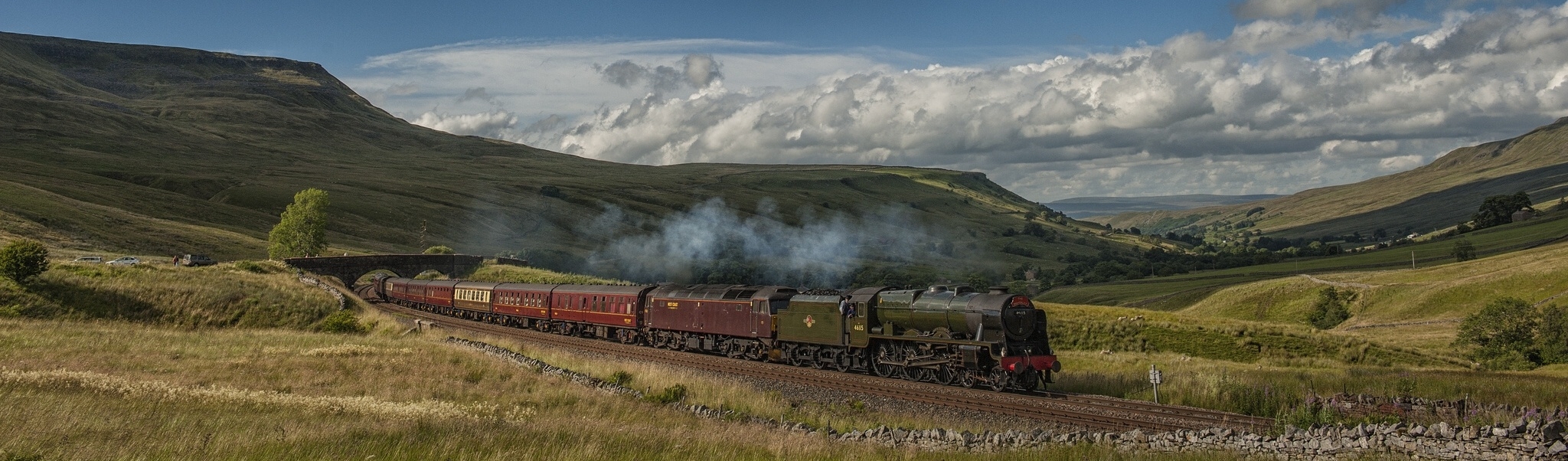



Louisville & Nashville class K-2
United States 1910 35 produced
Based on the K-1, the L&N ordered the K-2 in 1910, which was now operated with superheated steam. For this purpose, the number of tubes was more than halved in order to be able to accommodate flues with superheater elements. Rogers initially manufactured 20 of these locomotives, and 15 more were rebuilt from K-1.
Like most Pacifics in the USA, they initially hauled the main express trains, but after the introduction of more powerful locomotives they were increasingly pushed into service in front of regular passenger and commuter trains. The number 152, which was built as K-1, still exists today. It has been owned by the Kentucky Railroad Museum since 1957 and is currently being refurbished.
Technical data
General
- Built
- 1910
- Manufacturers
- Rogers
- Wheel arrangement
- 4-6-2 (Pacific)
- Gauge
- 1,435 mm (Standard gauge)
Dimensions and weights
- Wheelbase
- 9.20 m
- Total wheelbase
- 18.77 m
- Service mass
- 91.4 t
- Adhesion mass
- 57.3 t
- Total mass
- 156.4 t
- Rigid wheelbase
- 3.66 m
- Axle load
- 21.1 t
- Water capacity
- 26,498 l
- Fuel capacity
- 13.6 t (coal)
Boiler
- Grate area
- 4.181 m²
- Firebox surface
- 21.739 m²
- Tube heating surface
- 184.784 m²
- Evaporative heating surface
- 206.524 m²
- Superheater surface
- 40.877 m²
- Total heating surface
- 247.4 m²
Power plant
- Driver diameter
- 1,753 mm
- Boiler pressure
- 13.8 bar
- Expansion type
- simple expansion
- Cylinders
- two, 521 x 711 mm
Power
- Power source
- steam
- Estimated power
- 1,417 kW (1,927 PS)
- Starting effort
- 129.0 kN
Calculated values
- Factor of adhesion
- 1 : 4.36
- Optimal speed
- 68 km/h
- Power-to-weight ratio
- 15.5 kW/t
- Heating Surface Equivalent
- 397.0 m²
- Cylinder volume/HSE
- 1 : 763.00
- Adhesive weight/Total
- 1 : 1.59
- Tractive force/Heating surface
- 1 : 10.89
- Grate area/Heating surface
- 1 : 59.17
- Firebox/Tube surface
- 1 : 8.50
- Total/Superheater
- 1 : 5.05