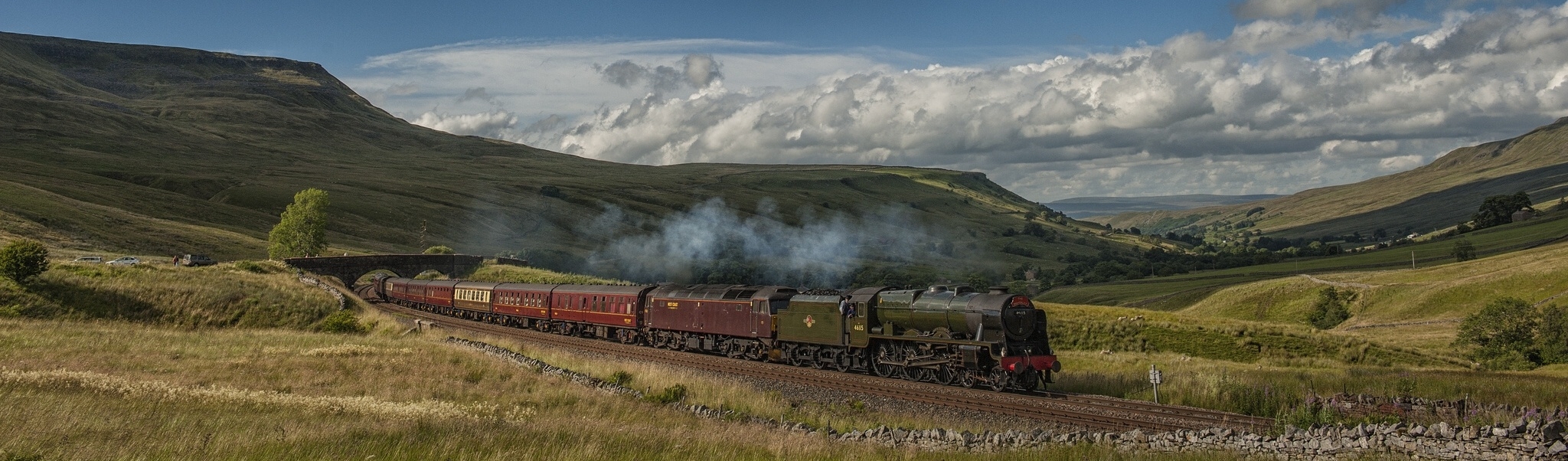



British Rail class 25 and Sulzer type 2
originally D5151
Great Britain 1961 327 produced

When it was noticed that the 75 mph (121 km/h) class 24 was too slow for many tasks, the 90 mph (145 km/h) class 25 was born. Thanks to an intercooler, the engine now produced 90 hp more. Several manufacturers delivered a total of 327 locomotives of subclasses 25/0 to 25/3, which mainly differed in terms of the electrics. They mainly hauled freight trains, but some locomotives had steam heating for passenger trains. They were called “Rats” because of their widespread use. Regular use ended in 1987. In 1983, three locomotives had been converted into electric train heaters, which were carried on trains and scrapped in 1994. Today a total of 20 class 25 units are being preserved.
Technical data
General
- Built
- 1961-1967
- Manufacturers
- Crewe, Darlington, Derby, Beyer, Peacock & Co.
- Wheel arrangement
- B-B
- Gauge
- 1,435 mm (Standard gauge)
Dimensions and weights
- Length
- 15.39 m
- Wheelbase
- 11.13 m
- Service mass
- 74.2 t
- Adhesion mass
- 74.2 t
- Axle load
- 18.6 t
Power plant
- Engine
- Sulzer 6LDA28-B
- Engine type
- 6-cyl. diesel
Power
- Power source
- diesel-electric
- Indicated power
- 932 kW (1,267 PS)
- Top speed
- 145 km/h
- Starting effort
- 173.5 kN
Calculated values
- Factor of adhesion
- 1 : 4.20
- Power-to-weight ratio
- 12.6 kW/t
- Adhesive weight/Total
- 1 : 1.00