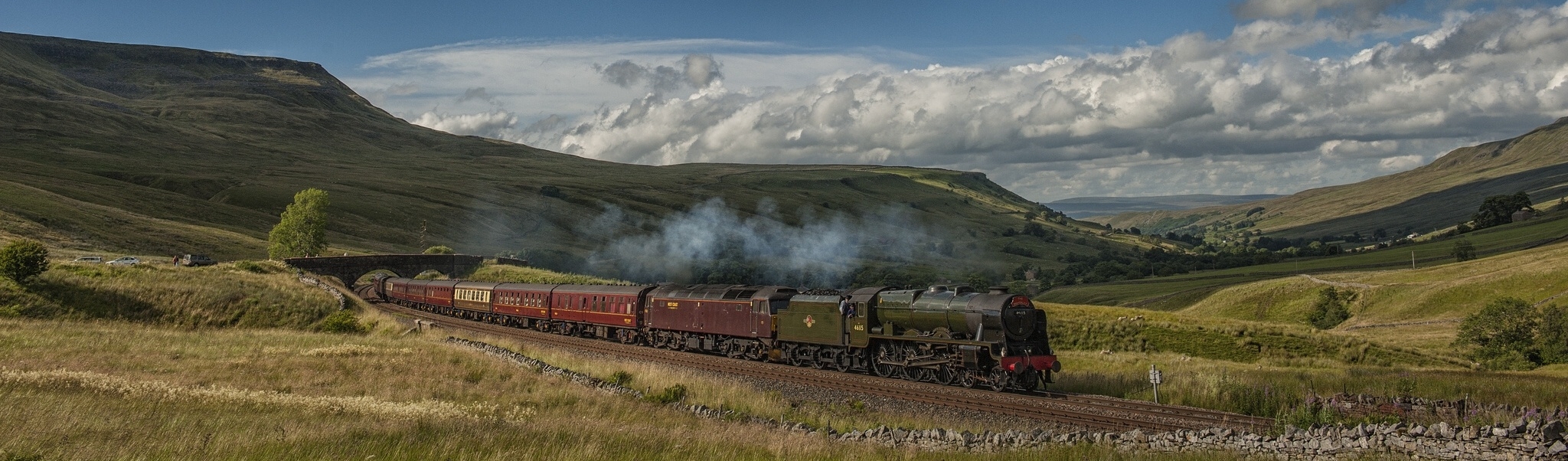



London, Midland & Scottish Stanier class 8F
Italian State Railway class 737 and Turkish State Railway 45151 to 45170
Since the LMS needed powerful goods locomotives to reduce the need for double-heading, Stanier designed the 8F as a 2-8-0 goods variant of his 4-6-0 “Black Five”. So apart from the changed wheel arrangement with smaller drivers, they had a similar tapered boiler with a Belpaire firebox and a small dome. They were not only built for the LMS, but were also selected as the British standard locomotive in World War II and also were used in Italy and the Middle East.
The LMS itself received 331 locomotives directly, with many built in their own works at Crewe and Horwich. The LNER bought 68 more, 208 were built for the War Department and 245 were built for the Railway Executive Committee for use with other operators. So in total, 852 locomotives were built by the works of all “Big Four” railways and commercial manufacturers.
In the War, they did not come into service in France since this country had already been invaded by Germany when they were ready. In 1944, the Middle East Forces sent 15 to Italy. After the war they were bought by the Italian State Railways. Designated class 737, they only operated until the early fifties.
Greater numbers were used in Egypt, Iran, Iraq, Palestine and Turkey. There they were not always without problems since they had been designed for use in Britain, but all in all they delivered good performances. While Egypt and Iran withdrew them in the sixties, Iraq used them until the seventies and also the locomotives from Palestine were used by Israel Railways until 1973. Turkey numbered its 20 locomotives starting with 45151 and even used them until the eighties.
British Railways inherited a total of 666 locomotives of this class. They were also used for passenger trains up to 60 mph (97 km/h) and some also received specially balanced wheelsets and motion for fast, fitted goods trains. In 1964, 664 were still in service and the last 150 survived until 1968, the last year of British steam traction. From 14 locomotives surviving in different countries, eight are situated in the UK. Two of these had returned from Turkey and are right hand drive.
Technical data
General
- Built
- 1935-1946
- Manufacturers
- Crewe, Horwich, North British, Darlington, Doncaster, Swindon, Vulcan Foundry, Brighton, Eastleigh, Ashford, Beyer, Peacock & Co.
- Wheel arrangement
- 2-8-0 (Consolidation)
- Gauge
- 1,435 mm (Standard gauge)
Dimensions and weights
- Length
- 19.22 m
- Wheelbase
- 8.10 m
- Total wheelbase
- 16.05 m
- Service mass
- 73.3 t
- Adhesion mass
- 63 t
- Rigid wheelbase
- 5.26 m
- Axle load
- 16.3 t
- Water capacity
- 18,185 l
- Fuel capacity
- 9.1 t (coal)
Boiler
- Grate area
- 2.662 m²
- Firebox surface
- 15.886 m²
- Tube heating surface
- 137.404 m²
- Evaporative heating surface
- 153.29 m²
- Superheater surface
- 19.974 m²
- Total heating surface
- 173.3 m²
Power plant
- Driver diameter
- 1,435 mm
- Boiler pressure
- 15.5 bar
- Expansion type
- simple expansion
- Cylinders
- two, 470 x 711 mm
Power
- Power source
- steam
- Estimated power
- 1,342 kW (1,825 PS)
- Starting effort
- 144.3 kN
Calculated values
- Factor of adhesion
- 1 : 4.28
- Optimal speed
- 56 km/h
- Power-to-weight ratio
- 18.3 kW/t
- Heating Surface Equivalent
- 272.7 m²
- Cylinder volume/HSE
- 1 : 904.67
- Adhesive weight/Total
- 1 : 1.16
- Tractive force/Heating surface
- 1 : 17.39
- Grate area/Heating surface
- 1 : 65.09
- Firebox/Tube surface
- 1 : 8.65
- Total/Superheater
- 1 : 7.67