


Southern Railway (UK) Merchant Navy class
Bulleid Heavy Pacific
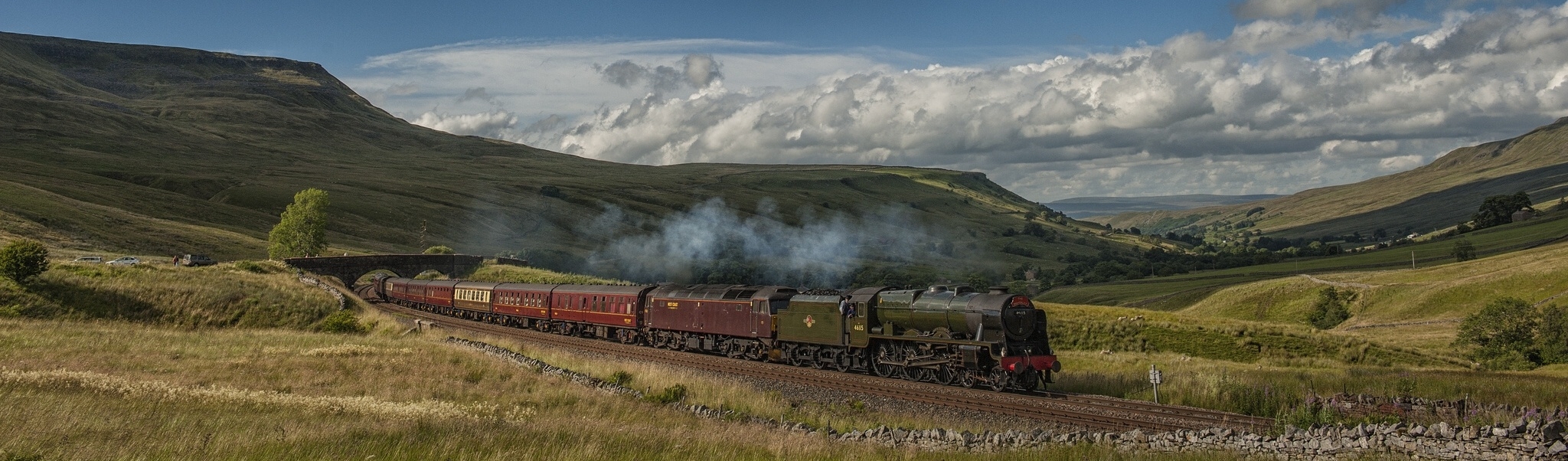
During the Second World War, the Southern Railway realized that it urgently needed new and more powerful express locomotives. These were primarily intended to be used in front of the increasingly heavier boat trains between London and the Channel coast. After there were initially considerations regarding the optimal wheel arrangement and eight-coupled machines were also considered, Oliver Bulleid decided on a Pacific.
Since there were restrictions on the construction of express locomotives due to the war, the new design was officially classified for mixed service and was designed so that it could also be used in front of freight trains if necessary. The driving wheel diameter of 6 ft 2 in (1,880 mm) was a compromise between tractive power and top speed. The three cylinders also promised starting without much slip.
A batch of ten locomotives was ordered in each of 1941 and 1944. A third order for another ten was placed a few months before nationalization and only built for British Railways in 1949. Better materials than those used in the war could now be used, which reduced the weight. The class was initially designated 21C1 and named “Merchant Navy”. The names of the individual locomotives came from merchant navy fleets that were used in the North Atlantic during World War II. A short time later, the smaller sister class called “West Country”/“Battle of Britain” was created. Both were therefore also known as “Bulleid Heavy Pacific” and “Bulleid Light Pacific”.
The locomotives immediately attracted attention with their casing, which earned them the nickname “Spam Cans”, after the canned meat known in Britain. However, the fairing was not used to reduce drag, but rather to divert smoke and make the locomotives' exterior smoother for cleaning in carriage washers. It soon became clear that the crews' visibility was often limited by the smoke.
The boiler was characterized by a high pressure of 280 psi (19.3 bars), as well as a combustion chamber and thermic syphons and had a welded firebox. The driving wheels and those of the tender were a special type of disc wheel that Bulleid had developed. For reasons of space, he also developed a special type of valve gear. Each cylinder had miniaturized Walschaert gear that ran in an oil bath and was driven by a camshaft, which in turn was turned by the driving axle via chains.
Since the casing and the chain drive turned out to be problematic, the entire class was rebuilt between 1956 and 1960. A main argument was the high consumption due to the special valve gear. The casing was removed and each cylinder was equipped with its own, conventional Walschaert valve gear. Additionally, the boiler pressure has been reduced from 280 to 250 psi to simplify maintenance. The Light Pacifics were also rebuilt in the same way.
Despite the lower boiler pressure, the rebuilt machines delivered very good performances. The highest recorded speed was 105.88 mph or 170 km/h. After the South Western Main Line was handed over to Western Region administration and the class 42 diesel-hydraulics were introduced, the Merchant Navy was withdrawn between 1964 and 1967. Today, eleven of the 30 locomotives are still preserved, five of which were at least at one time operational again. These are all in rebuilt condition, but No. 35011 “General Steam Navigation” is being checked to restore it to its original condition.
Technical data
General
| Property | as built | rebuilt |
|---|---|---|
| Built | 1941-1949 | 1956-1960 |
| Manufacturers | Eastleigh | |
| Wheel arrangement | 4-6-2 (Pacific) | |
| Gauge | 1,435 mm (Standard gauge) | |
Dimensions and weights
| Property | as built | rebuilt |
|---|---|---|
| Wheelbase | 11.20 m | |
| Total wheelbase | 18.75 m | |
| Empty mass | 86 t | |
| Service mass | 96.3 t | 99.5 t |
| Adhesion mass | 57.2 t | |
| Rigid wheelbase | 4.57 m | |
| Axle load | 21.3 t | |
| Water capacity | 22,731 l | |
| Fuel capacity | 5.1 t (coal) | |
Boiler
| Property | as built | rebuilt |
|---|---|---|
| Grate area | 4.506 m² | |
| Firebox surface | 25.548 m² | |
| Tube heating surface | 202.157 m² | |
| Evaporative heating surface | 227.706 m² | |
| Superheater surface | 81.941 m² | |
| Total heating surface | 309.6 m² | |
Power plant
| Property | as built | rebuilt |
|---|---|---|
| Driver diameter | 1,880 mm | |
| Boiler pressure | 19.3 bar | 17.2 bar |
| Expansion type | simple expansion | |
| Cylinders | three, 457 x 610 mm | |
Power
| Property | as built | rebuilt |
|---|---|---|
| Power source | steam | |
| Estimated power | 2,163 kW (2,941 PS) | 2,051 kW (2,789 PS) |
| Starting effort | 166.9 kN | 149.0 kN |
Calculated values
| Property | as built | rebuilt |
|---|---|---|
| Factor of adhesion | 1 : 3.36 | 1 : 3.77 |
| Optimal speed | 79 km/h | 84 km/h |
| Power-to-weight ratio | 22.5 kW/t | 20.6 kW/t |
| Heating Surface Equivalent | 519.3 m² | |
| Cylinder volume/HSE | 1 : 578.13 | |
| Adhesive weight/Total | 1 : 1.68 | 1 : 1.74 |
| Tractive force/Heating surface | 1 : 11.26 | 1 : 10.05 |
| Grate area/Heating surface | 1 : 68.72 | |
| Firebox/Tube surface | 1 : 7.91 | |
| Total/Superheater | 1 : 2.78 | |