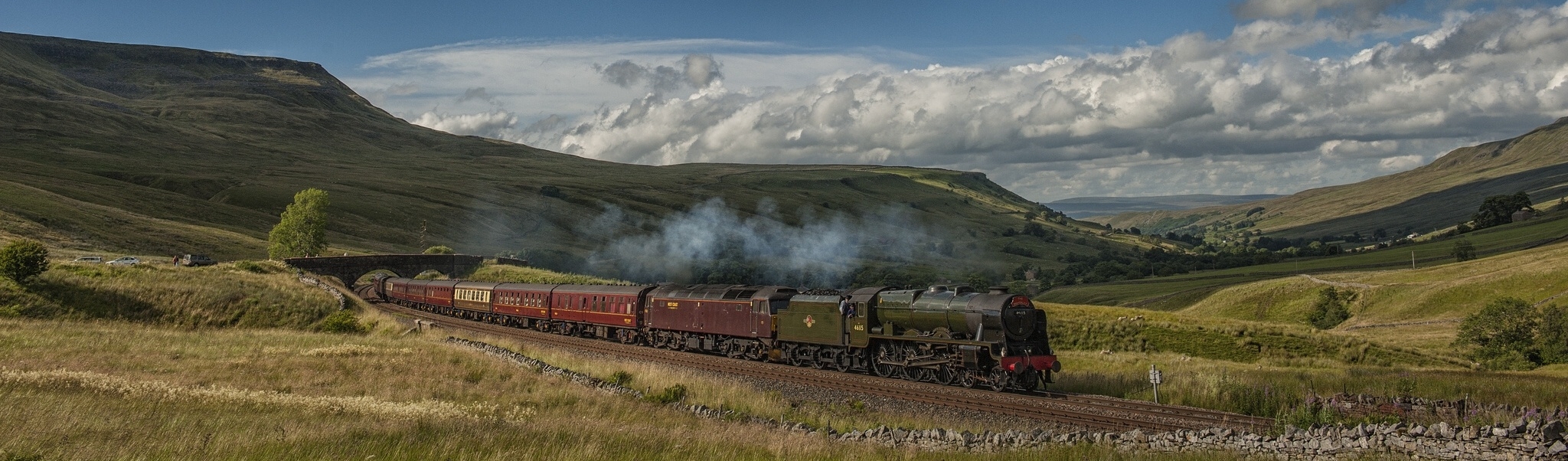



Württemberg C
German Reichsbahn class 181
The class C was the lightest Pacific locomotive from the Länderbahn era. As elsewhere, they were developed because the four-coupled express locomotives were no longer sufficient for the constantly increasing weight of the express trains at the beginning of the 20th century. As with the Bavarian S 3/6, the topography of the country played a role in the development, and the driving wheels of the C were made even smaller with a diameter of 1,800 mm. Therefore, the locomotives could only reach a maximum speed of 110 to 120 km/h, but despite their low weight they had a high tractive effort. In addition, it turned out that they were also very economical in terms of the consumption of coal and water.
The class C locomotives could be easily distinguished from other Pacific machines by their special design features. The most noticeable was the outside sub frame, which supported the inside plate frame and also contained wheel housings for the driving wheels. Due to the large firebox relative to the overall dimensions of the locomotive, the trailing axle had to be pulled far back, which is why it protrudes behind the cab.
On the power side, a four-cylinder compound engine was also used in Württemberg, in this case all cylinders acted on the second driving axle. To increase efficiency through lower air resistance, the smoke box was designed in a conical shape and the cab had a special, streamlined shape with a smooth transition from the boiler to the roof. In addition, as with the S 2/6, the dome and sandbox were housed under a common cover. The performance program to be fulfilled included trains weighing 350 tonnes, which had to be hauled at 100 km/h on the flat and at 60 km/h on one percent.
Production began in 1909 in the Esslingen machine factory with just five locomotives, which were to remain the only ones for the time being. Further were not built until 1914, so that the total number had risen to 41 by 1921. These locomotives, also known as the “beautiful Württemberg lady”, were used on trains such as the Orient Express. After the war, a total of four had to be handed over to France and Poland, all others and those completed in the following years were taken over by the Reichsbahn as class 181.
During this time, all continued to be used almost exclusively on lines which were within Württemberg or started in Württemberg. The smaller of the two tenders used were replaced by Prussian ones with a larger capacity. After the Second World War, there were still 23 operational locomotives in the Bundesbahn, which were retired between 1952 and 1955 due to their small number and all scrapped.
Technical data
General
| Property | 1909 variant | 1921 variant |
|---|---|---|
| Built | 1909-1921 | |
| Manufacturers | Esslingen | |
| Wheel arrangement | 4-6-2 (Pacific) | |
| Gauge | 1,435 mm (Standard gauge) | |
Dimensions and weights
| Property | 1909 variant | 1921 variant |
|---|---|---|
| Length | 20.43 m | |
| Length loco | 13.14 m | |
| Wheelbase | 11.04 m | |
| Empty mass | 75.9 t | |
| Service mass | 85.2 t | 87.6 t |
| Adhesion mass | 47.7 t | 48 t |
| Total mass | 147.4 t | 149.8 t |
| Rigid wheelbase | 3.80 m | 4.25 m |
| Axle load | 15.9 t | 16 t |
| Water capacity | 20,000 l | 30,000 l |
| Fuel capacity | 6 t (coal) | 10 t (coal) |
Boiler
| Property | 1909 variant | 1921 variant |
|---|---|---|
| Grate area | 3.96 m² | 3.95 m² |
| Firebox surface | 14.96 m² | |
| Tube heating surface | 192.94 m² | 192.75 m² |
| Evaporative heating surface | 207.9 m² | 207.71 m² |
| Superheater surface | 54.46 m² | 64.96 m² |
| Total heating surface | 262.4 m² | 272.7 m² |
Power plant
| Property | 1909 variant | 1921 variant |
|---|---|---|
| Driver diameter | 1,800 mm | |
| Boiler pressure | 15 bar | |
| Expansion type | compound | |
| Cylinders | four, HP: 420 x 612 mm and LP: 620 x 612 mm | |
Power
| Property | 1909 variant | 1921 variant |
|---|---|---|
| Power source | steam | |
| Indicated power | 1,353 kW (1,840 PS) | |
| Top speed | 110 km/h | 120 km/h |
| Starting effort | 104.8 kN | |
| Starting effort simple | 125.8 kN | |
Calculated values
| Property | 1909 variant | 1921 variant |
|---|---|---|
| Factor of adhesion | 1 : 4.46 | 1 : 4.49 |
| Optimal speed | 79 km/h | |
| Power-to-weight ratio | 15.9 kW/t | 15.4 kW/t |
| Heating Surface Equivalent | 391.6 m² | 412.4 m² |
| Cylinder volume/HSE | 1 : 904.82 | 1 : 859.16 |
| Adhesive weight/Total | 1 : 1.79 | 1 : 1.83 |
| Tractive force/Heating surface | 1 : 8.35 | 1 : 8.03 |
| Grate area/Heating surface | 1 : 66.25 | 1 : 69.03 |
| Firebox/Tube surface | 1 : 12.90 | 1 : 12.88 |
| Total/Superheater | 1 : 3.82 | 1 : 3.20 |