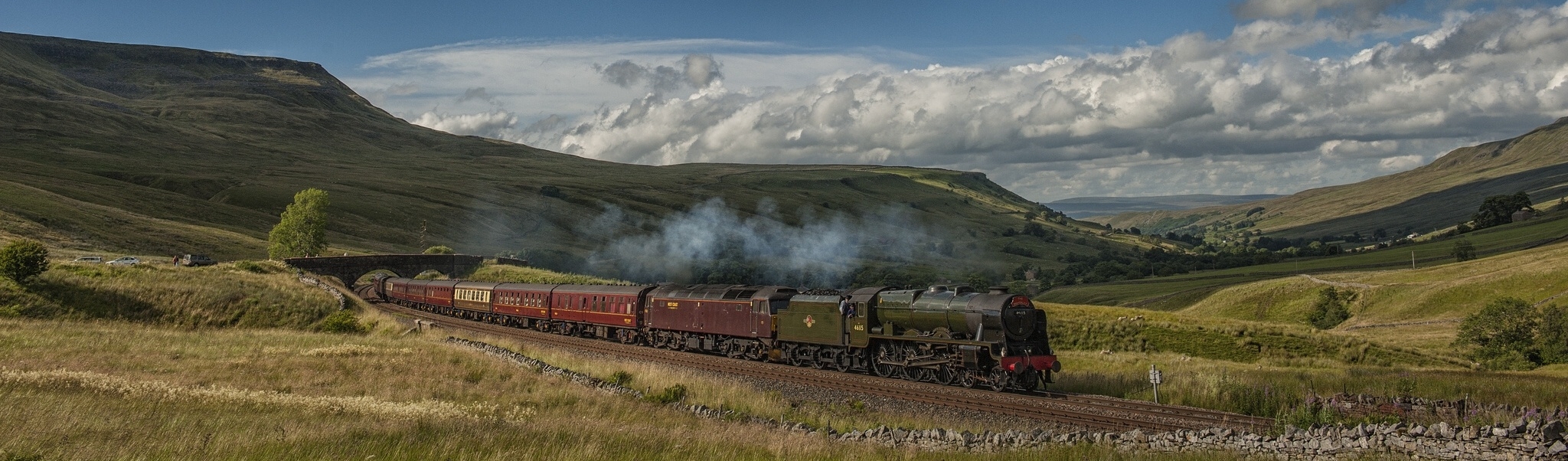



US Railroad Administration Light Mikado
United States 1918 625 produced

Since the 2-8-2 wheel arrangement had now become the US standard for lighter freight trains, the USRA designed the Light Mikado as the standard type for this purpose. It is considered the first USRA design to enter service. With cylinders measuring 26 by 30 inches and drivers with a diameter of 63 inches, sufficient pulling power was available for the lighter freight trains and a top speed of around 65 mph was achieved. The largest order came from the Baltimore & Ohio, which used a total of 100 as class Q-3. The Q-3 No. 4500 was the first USRA locomotive ever and is one of nine surviving Light Mikados.
Technical data
General
- Built
- 1918-1922
- Manufacturers
- ALCO, Baldwin, Lima
- Wheel arrangement
- 2-8-2 (Mikado)
- Gauge
- 1,435 mm (Standard gauge)
Dimensions and weights
- Wheelbase
- 11.00 m
- Total wheelbase
- 21.74 m
- Service mass
- 131.9 t
- Adhesion mass
- 100.5 t
- Total mass
- 217.3 t
- Rigid wheelbase
- 5.11 m
- Water capacity
- 37,854 l
- Fuel capacity
- 14.5 t (coal)
Boiler
- Grate area
- 6.197 m²
- Firebox surface
- 26.013 m²
- Tube heating surface
- 325.44 m²
- Evaporative heating surface
- 351.453 m²
- Superheater surface
- 81.941 m²
- Total heating surface
- 433.4 m²
Power plant
- Driver diameter
- 1,600 mm
- Boiler pressure
- 13.8 bar
- Expansion type
- simple expansion
- Cylinders
- two, 660 x 762 mm
Power
- Power source
- steam
- Estimated power
- 2,200 kW (2,991 PS)
- Starting effort
- 243.4 kN
Calculated values
- Factor of adhesion
- 1 : 4.05
- Optimal speed
- 55 km/h
- Power-to-weight ratio
- 16.7 kW/t
- Heating Surface Equivalent
- 645.4 m²
- Cylinder volume/HSE
- 1 : 808.84
- Adhesive weight/Total
- 1 : 1.31
- Tractive force/Heating surface
- 1 : 11.73
- Grate area/Heating surface
- 1 : 69.94
- Firebox/Tube surface
- 1 : 12.51
- Total/Superheater
- 1 : 4.29