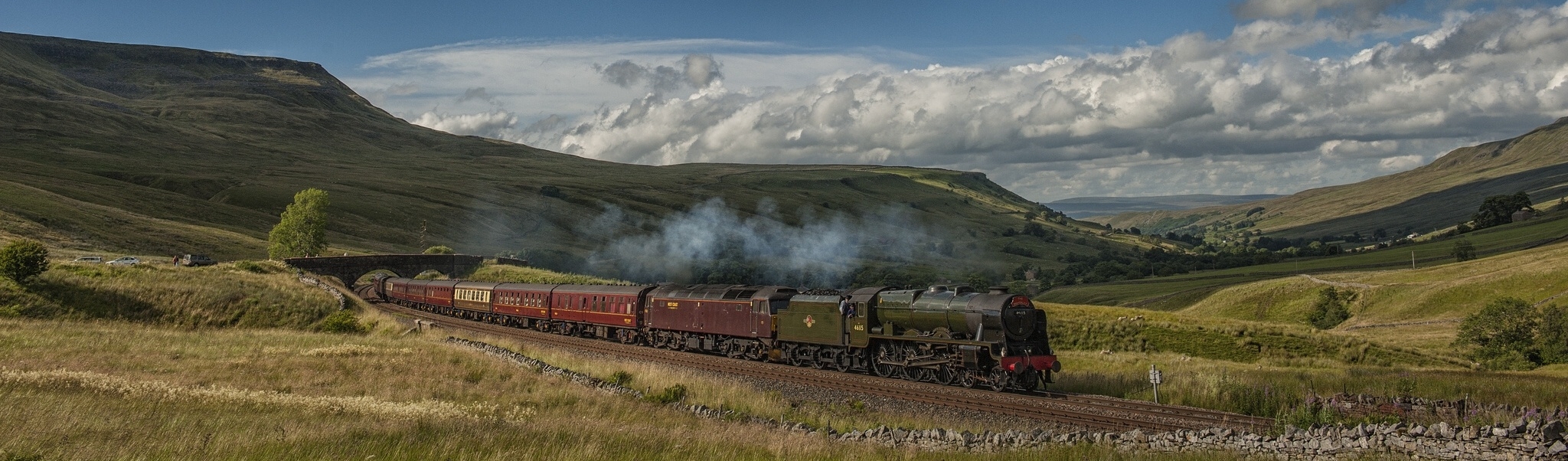



US Railroad Administration 2-6-6-2 (Light Mallet)
Chesapeake & Ohio class H-6
The second largest of the steam locomotive types standardized by the United States Railroad Administration during World War I was a Mallet with a 2-6-6-2 wheel arrangement. The basis for this design were the H-2 and H-4 classes of the Chesapeake and Ohio, which had been built from 1911. The aim of the development of these locomotives at the C&O was to obtain more powerful locomotives than the Consolidations used for pulling heavy coal trains, but which still have good curve running characteristics. After a single H-1 was built with a saturated boiler in 1910 and hauled trains weighing 3,800 tons, the other locomotives were built with superheaters.
Like the H-2 and H-4, the standard USRA locomotives had an axle load of only 60.100 pounds, which meant that they could also be used on less developed lines. Compared to the older Consolidations they replaced, they could haul a heavier load alone than two of the older locos combined, while still using less coal. The low consumption was also due to the fact that, in contrast to many later American articulated locomotives, they were “real” Mallets and therefore had a compound engine. The high-pressure cylinders were on the rear group of drivers, which was fixed to the frame, and the low-pressure cylinders on the front, flexible group.
Only 30 of the actual standard design were built until about 1940, which were delivered to the C&O and to the Wheeling and Lake Erie Railway. Some W&LE locomotives were later leased to the Nickel Plate Road. The C&O soon decided to procure a version that was slightly adapted to their own needs instead of the standardized version. This was produced in smaller numbers as the H-6 until 1949 and adapted to modern developments over time. The innovations included roller bearings, an automatic lubrication system and a stoker. The last two ones built bore the numbers 1308 and 1309 at the C&O. They were only used from their commissioning in 1949 until 1956 and were the last steam locomotives that Baldwin built for an American company. Today, the restored 1308 sits in Huntington, West Virginia, while 1309 returned to service on the Western Maryland Scenic Railroad on December 31, 2020.
Technical data
General
- Built
- 1918-1923, 1949
- Manufacturers
- ALCO, Baldwin
- Wheel arrangement
- 2-6-6-2 (Mallet Mogul)
- Gauge
- 1,435 mm (Standard gauge)
Dimensions and weights
- Length
- 30.39 m
- Wheelbase
- 15.16 m
- Total wheelbase
- 27.25 m
- Service mass
- 203.2 t
- Adhesion mass
- 162.4 t
- Total mass
- 296.9 t
- Rigid wheelbase
- 3.20 m
- Axle load
- 27.3 t
- Water capacity
- 45,425 l
- Fuel capacity
- 14.5 t (coal)
Boiler
- Grate area
- 7.089 m²
- Firebox surface
- 38.648 m²
- Tube heating surface
- 467.024 m²
- Evaporative heating surface
- 505.672 m²
- Superheater surface
- 120.031 m²
- Total heating surface
- 625.7 m²
Power plant
- Driver diameter
- 1,448 mm
- Boiler pressure
- 15.5 bar
- Expansion type
- compound
- Cylinders
- four, HP: 584 x 813 mm and LP: 889 x 813 mm
Power
- Power source
- steam
- Estimated power
- 2,610 kW (3,549 PS)
- Starting effort
- 352.9 kN
- Starting effort simple
- 423.5 kN
Calculated values
- Factor of adhesion
- 1 : 4.51
- Optimal speed
- 45 km/h
- Power-to-weight ratio
- 12.8 kW/t
- Heating Surface Equivalent
- 939.0 m²
- Cylinder volume/HSE
- 1 : 1,001.37
- Adhesive weight/Total
- 1 : 1.25
- Tractive force/Heating surface
- 1 : 11.78
- Grate area/Heating surface
- 1 : 88.26
- Firebox/Tube surface
- 1 : 12.08
- Total/Superheater
- 1 : 4.21