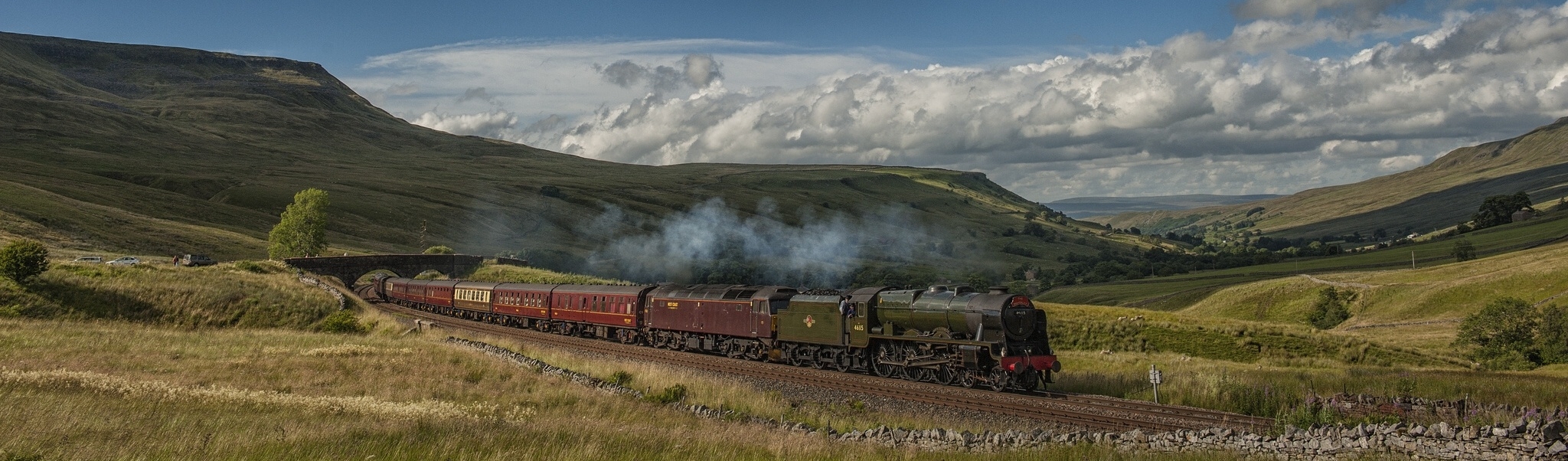




Great Western Railway Dean Express 2-4-0
In the late 1880s, when the broad gauge was nearing its end, William Dean still saw the demand for fast express locomotives. Their task were trains between London and Bristol which had to run at a constant high speed. The result were the numbers 14 and 16 built in 1888 at Swindon which only operated in their original form until 1892 when all broad gauge operations were stopped and the lines re-gauged. They had the wheel arrangement 2-4-0, drivers of seven feet and a large, long boiler. In 1892, they were rebuilt into standard gauge 4-4-0 locomotives. Named “Charles Saunders” and “Brunel”, now formed the Armstrong class together with two other rebuilt ex broad gauge locomotives. They were rebuilt again from 1915 and became members of the Flower class.
Technical data
General
- Built
- 1888
- Manufacturers
- Swindon
- Wheel arrangement
- 2-4-0 (Porter)
- Gauge
- 2,140 mm (GWR broad gauge)
Dimensions and weights
- Wheelbase
- 5.64 m
- Service mass
- 44.7 t
- Adhesion mass
- 31.4 t
- Rigid wheelbase
- 5.64 m
Boiler
- Grate area
- 1.932 m²
- Firebox surface
- 11.464 m²
- Tube heating surface
- 133.279 m²
- Evaporative heating surface
- 144.743 m²
- Total heating surface
- 144.7 m²
Power plant
- Driver diameter
- 2,146 mm
- Boiler pressure
- 11 bar
- Expansion type
- simple expansion
- Cylinders
- two, 508 x 610 mm
Power
- Power source
- steam
- Estimated power
- 522 kW (710 PS)
- Starting effort
- 68.7 kN
Calculated values
- Factor of adhesion
- 1 : 4.48
- Optimal speed
- 47 km/h
- Power-to-weight ratio
- 11.7 kW/t
- Heating Surface Equivalent
- 202.1 m²
- Cylinder volume/HSE
- 1 : 1,222.94
- Adhesive weight/Total
- 1 : 1.42
- Tractive force/Heating surface
- 1 : 9.92
- Grate area/Heating surface
- 1 : 74.92
- Firebox/Tube surface
- 1 : 11.63