


Victorian Railways class R
Australia 1951 70 produced
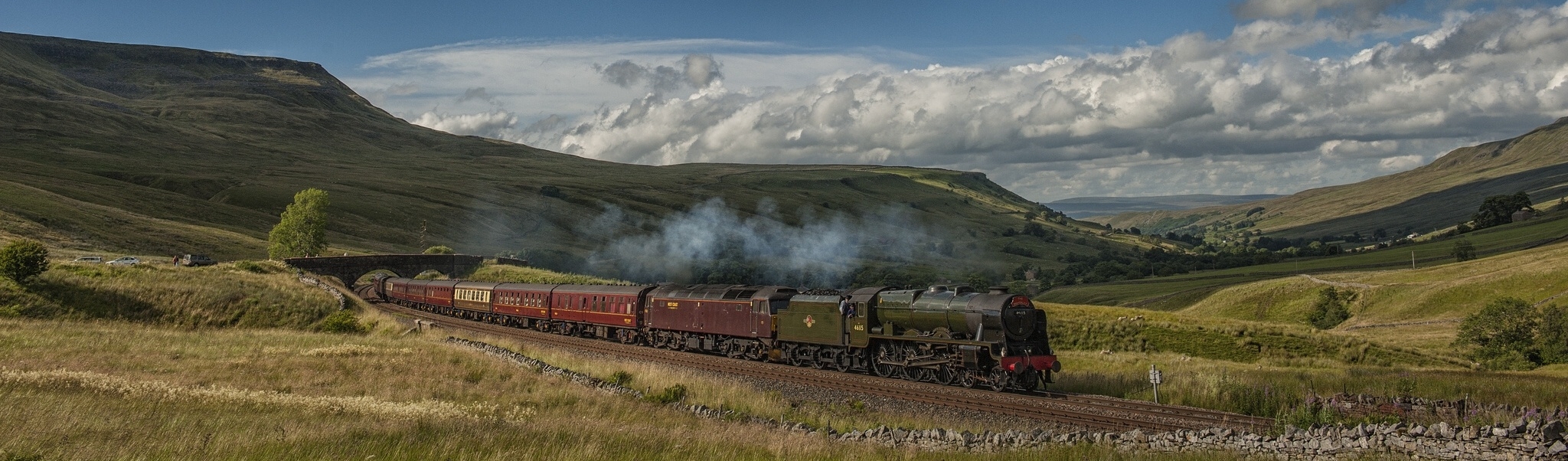
The class R was only created after the Second World War as an express locomotive to replace the class A2 ten-wheelers. By installing a stoker, they wanted to ensure that it would perform well with coal of varying grades. The 70 locos arrived at the same time as some diesel and electric locos, giving them a very short career in service pulling express trains. They were then put into a wide variety of services, in which they performed well despite often poor maintenance. Today there are still six locomotives, four of which are still operational and partly had multiple operators. The R 766 was even converted to standard gauge.
Technical data
General
- Built
- 1951-1953
- Manufacturers
- North British
- Wheel arrangement
- 4-6-4 (Hudson)
- Gauge
- 1,600 mm (Irish broad gauge)
Dimensions and weights
- Length
- 23.55 m
- Wheelbase
- 11.05 m
- Total wheelbase
- 20.42 m
- Service mass
- 108.9 t
- Adhesion mass
- 59.4 t
- Total mass
- 189.8 t
- Rigid wheelbase
- 3.91 m
- Axle load
- 19.8 t
- Water capacity
- 40,917 l
- Fuel capacity
- 6.1 t (coal)
Boiler
- Grate area
- 3.902 m²
- Firebox surface
- 26.477 m²
- Tube heating surface
- 181.904 m²
- Evaporative heating surface
- 208.382 m²
- Superheater surface
- 42.921 m²
- Total heating surface
- 251.3 m²
Power plant
- Driver diameter
- 1,854 mm
- Boiler pressure
- 14.8 bar
- Expansion type
- simple expansion
- Cylinders
- two, 540 x 711 mm
Power
- Power source
- steam
- Estimated power
- 1,641 kW (2,231 PS)
- Starting effort
- 140.8 kN
Calculated values
- Factor of adhesion
- 1 : 4.14
- Optimal speed
- 71 km/h
- Power-to-weight ratio
- 15.1 kW/t
- Heating Surface Equivalent
- 426.6 m²
- Cylinder volume/HSE
- 1 : 762.90
- Adhesive weight/Total
- 1 : 1.83
- Tractive force/Heating surface
- 1 : 11.70
- Grate area/Heating surface
- 1 : 64.40
- Firebox/Tube surface
- 1 : 6.87
- Total/Superheater
- 1 : 4.86