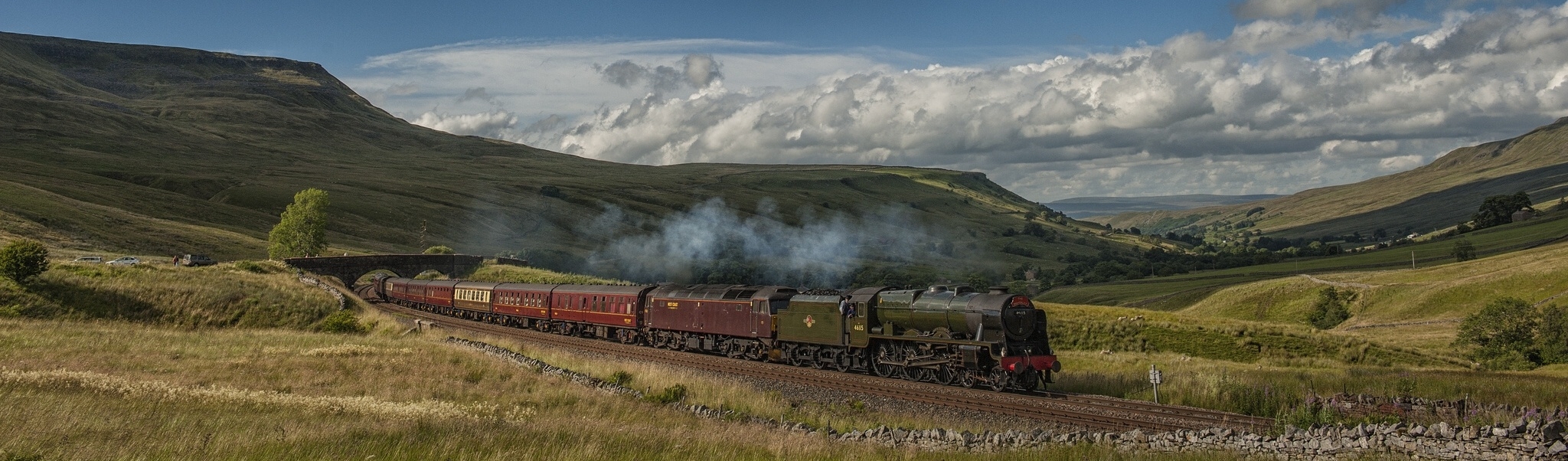



Japanese Government Railways class C51, originally class 18900
China Railway SL9

The locomotive later known as class C51 was introduced in 1919 to increase the speed of long-distance express trains. Following suggestions of German engineers to keep the rotational speed of the drivers below 300 rpm, the driver diameter chosen for a design speed of 100 km/h was 1,750 mm. This was not only a large value compared to the Cape gauge of 1,067 mm, they were also the largest drivers for a narrow gauge locomotive at this time. The boiler was large and benefited from the trailing axle that allowed for a large firebox that also had arch tubes. They were originally numbered in the range from 18900 and became class C51 in 1928.
The first 18 were built by the JGR itself. Parts came from different workshops and were assembled at Hamamatsu. The biggest part of the production came from Kisha Seizō which delivered 249. Finally, Mitsubishi started to build a batch of 22 in 1924. Approved for a speed of 95 km/h, one managed to reach 120 km/h on a test run with two coaches. Over the years, individual locomotives were fitted with measures to increase their efficiency. These included extended smoke boxes, double chimneys and partial streamlining, but all were later removed again.
From 1930, the C51 also hauled the famous Tsubame (Swallow) express between Tokyo and Kōbe in nine hours. In 1939, 16 locomotives were rebuilt to standard gauge and brought to the Japanese-controlled Central China Railway to remedy a severe locomotive shortage. These were called “Pashina” and later became the China Railway SL9 to be withdrawn only in 1990. In Japan, they were mainly used on regional main lines after the war. The last ones were withdrawn in 1966 and five were preserved, four of which are still existing on static display.
Technical data
General
- Built
- 1919-1928
- Manufacturers
- Kisha Seizō, Mitsubishi, Hamamatsu
- Wheel arrangement
- 4-6-2 (Pacific)
- Gauge
- 1,067 mm (Cape gauge)
Dimensions and weights
- Length
- 19.99 m
- Wheelbase
- 10.00 m
- Total wheelbase
- 17.77 m
- Service mass
- 67.8 t
- Adhesion mass
- 43.9 t
- Total mass
- 111.6 t
- Rigid wheelbase
- 3.80 m
- Axle load
- 14.6 t
- Water capacity
- 17,000 l
- Fuel capacity
- 8 t (coal)
Boiler
- Grate area
- 2.53 m²
- Firebox surface
- 12.4 m²
- Tube heating surface
- 115 m²
- Evaporative heating surface
- 127.4 m²
- Superheater surface
- 41.4 m²
- Total heating surface
- 168.8 m²
Power plant
- Driver diameter
- 1,750 mm
- Boiler pressure
- 13 bar
- Expansion type
- simple expansion
- Cylinders
- two, 530 x 660 mm
Power
- Power source
- steam
- Indicated power
- 864 kW (1,175 PS)
- Top speed
- 95 km/h
- Starting effort
- 117.1 kN
Calculated values
- Factor of adhesion
- 1 : 3.68
- Optimal speed
- 45 km/h
- Power-to-weight ratio
- 12.8 kW/t
- Heating Surface Equivalent
- 272.2 m²
- Cylinder volume/HSE
- 1 : 1,069.86
- Adhesive weight/Total
- 1 : 1.54
- Tractive force/Heating surface
- 1 : 14.48
- Grate area/Heating surface
- 1 : 66.72
- Firebox/Tube surface
- 1 : 9.27
- Total/Superheater
- 1 : 3.08