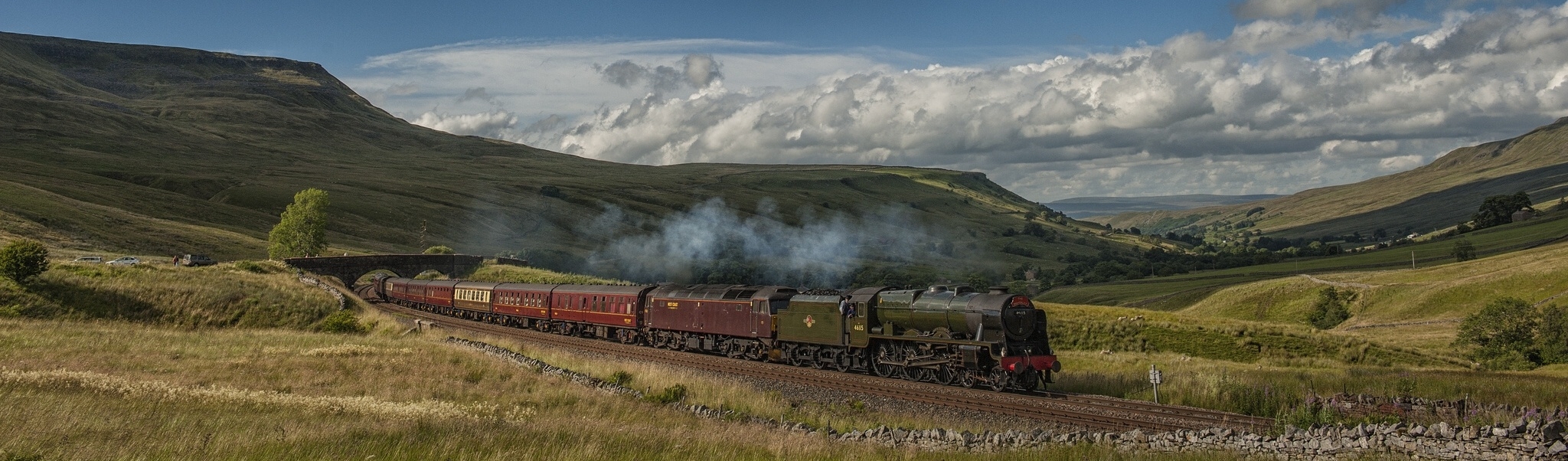
The K III and from 1900 III K were tank locomotives for narrow-gauge railways with many curves and gradients, which were designed in an unusual and complicated way to better adapt to their area of application. Their development became necessary because the I K, which had only been procured since 1881, no longer had sufficient power, especially on mountainous routes.
The special feature of the III K was a combination of a supporting tender and a Klose engine, which gave it a striking appearance and good driving characteristics in curves. Since the firebox was far behind the last driving axle, the single-axle tender was firmly connected to the locomotive with a ball joint and at the same time formed the rear half of the driver's cab. The first and last of the three sets of driving wheels were designed to be radially adjustable, whereby their deflection was controlled by the movement of the tender via a lever linkage. The power was provided by two inside cylinders, which gave their power to the external coupling rods via gears. The latter also had to be designed to be flexible due to the movable axles, which led to a great deal of effort in terms of construction and maintenance. The train was braked using a Heberlein brake, which was controlled by a cable and pulleys on the top of the locomotive and cars.
The first two examples were delivered by Krauss in Munich in 1889, another four followed in 1891 by Sächsische Maschinenfabrik Hartmann. Other, almost identical machines were delivered to the Yugoslav State Railways, where they were used until the 1960s. No further purchases of the III K were made, since the much less complex IV K bogie locomotive was already being manufactured from 1892. After being taken over by the Reichsbahn, the locomotives were used until 1923 and then parked for the time being. In 1925 the numbers from 99 7541 were still provided for the six locomotives, but they were no longer renumbered due to the soon to be phase out.