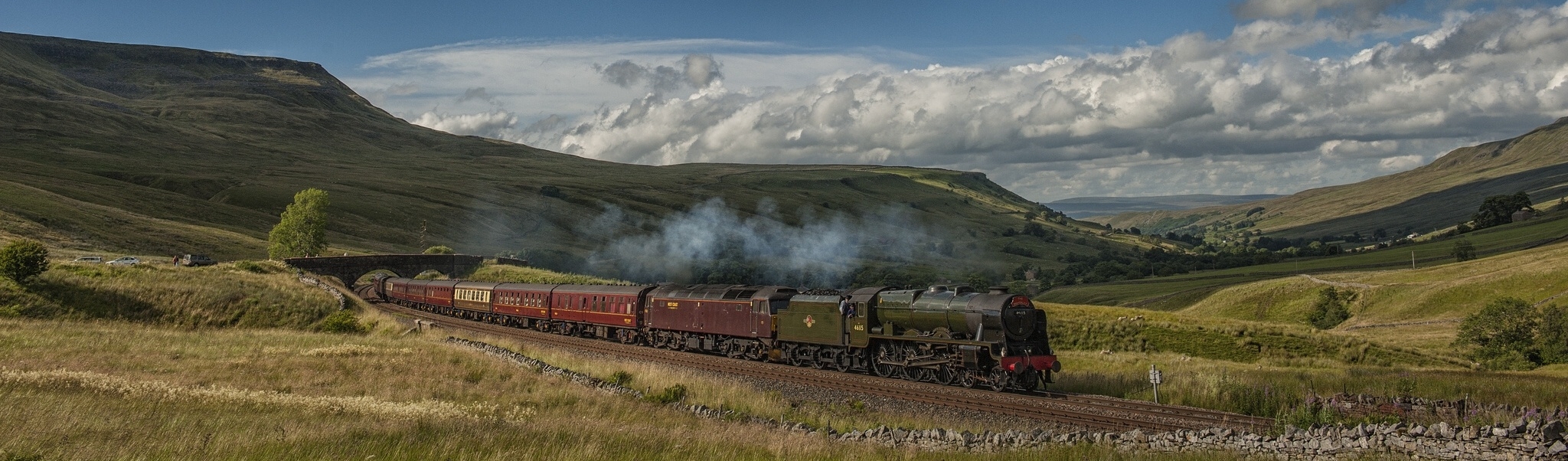



Great Western Railway class 7800 “Manor”
The Manor class was designed in the late thirties when the GWR found out that the axle load of the mixed-traffic Grange class was too high for many lines. Therefore Charles Collett had the lighter Swindon No. 14 boiler designed, combined with a cylinder diameter that had been decreased by half an inch compared to the Grange. As with the Grange, the driving wheels, many motion components and the tenders were taken from old class 4300 Moguls. In the result the axle load had been reduced by more than a ton. After the first batch from 1938 and 1939, British Railways built another batch of ten in 1950. They were numbered 7800 to 7829 and named after Manors in the GWR area.
They could be used on many secondary lines in Wales and Devon. One task was to haul the Cambrian Coast Express on the last stretches where the Castle or King class were too heavy. Furthermore, they could operate into Cornwall since they were light enough for the Royal Albert Bridge. On the other side, they had a poorer steaming capacity than expected, what could not only be traced back to the small grate. After this had been investigated in 1951, their blast pipe area was reduced and air flow in the grate was improved. After this, they delivered nearly the same power as the Grange.
The first one was withdrawn in 1963 and all others followed in 1964 and 1965. Remarkably, nine of the class of 30 locomotives were preserved. While these include four of the original batch of locomotives built by the GWR, five out of ten of the BR batch still exist. All of these had run in preservation at some point. Four of these are still in working order today.
Technical data
General
- Built
- 1938-1939, 1950
- Manufacturers
- Swindon
- Wheel arrangement
- 4-6-0 (Ten-wheeler)
- Gauge
- 1,435 mm (Standard gauge)
Dimensions and weights
- Length
- 18.83 m
- Wheelbase
- 8.26 m
- Total wheelbase
- 15.89 m
- Service mass
- 70 t
- Adhesion mass
- 51.2 t
- Total mass
- 110.6 t
- Rigid wheelbase
- 4.50 m
- Axle load
- 17.5 t
- Water capacity
- 15,910 l
- Fuel capacity
- 7.1 t (coal)
Boiler
- Grate area
- 2.053 m²
- Firebox surface
- 13.006 m²
- Tube heating surface
- 119.427 m²
- Evaporative heating surface
- 132.433 m²
- Superheater surface
- 17.652 m²
- Total heating surface
- 150.1 m²
Power plant
- Driver diameter
- 1,727 mm
- Boiler pressure
- 15.5 bar
- Expansion type
- simple expansion
- Cylinders
- two, 457 x 762 mm
Power
- Power source
- steam
- Estimated power
- 969 kW (1,317 PS)
- Starting effort
- 121.6 kN
Calculated values
- Factor of adhesion
- 1 : 4.13
- Optimal speed
- 48 km/h
- Power-to-weight ratio
- 13.8 kW/t
- Heating Surface Equivalent
- 232.8 m²
- Cylinder volume/HSE
- 1 : 1,074.89
- Adhesive weight/Total
- 1 : 1.37
- Tractive force/Heating surface
- 1 : 16.92
- Grate area/Heating surface
- 1 : 73.11
- Firebox/Tube surface
- 1 : 9.18
- Total/Superheater
- 1 : 7.50