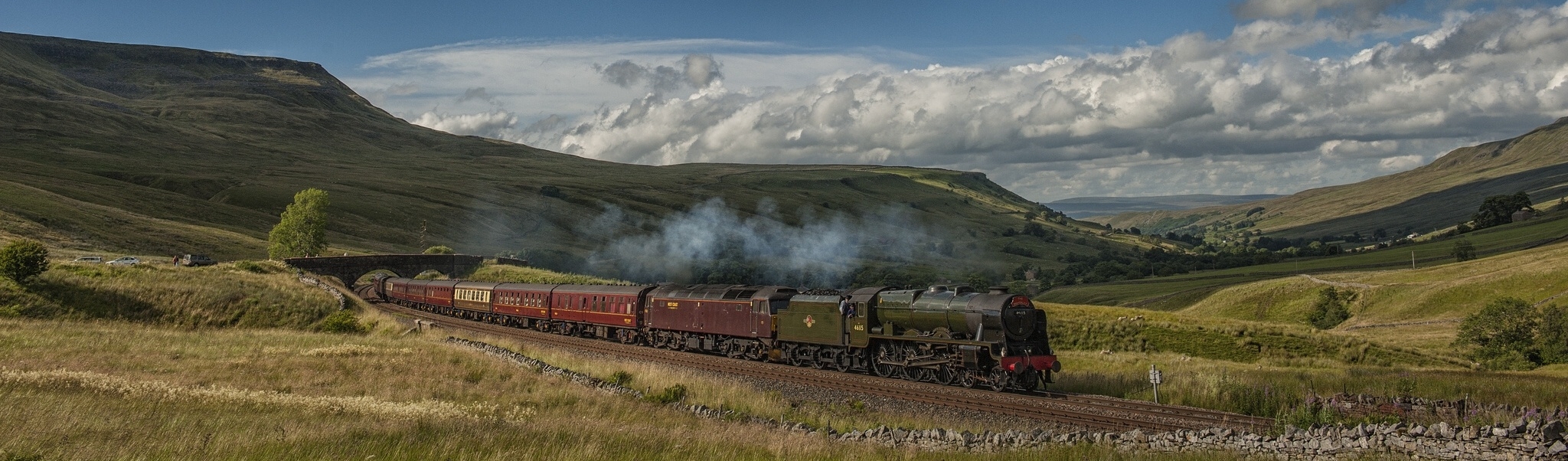



British Rail class 40 and English Electric type 4
originally D200

The ten prototypes with the numbers D200 to D209 were delivered in 1958 as the first large diesel locomotives to be series-built by English Electric. They were based on the three experimental D16/2 completed in 1950 and 1954. Like the third D16/2, the production variant still used the same 16SVT engine with 2,000 hp and the same bogies. The bogies, each with three powered axles, also had a leading axle each in order to be able to carry the heavy weight. The body of the production locomotives deviated from the D16/2 and already had the shapes that were later to be found on the classes 37 and 55.
Another 190 production locomotives followed until 1962 as the D210 to D399, which later became known as the class 40. The first batch only received a vacuum brake system, the later ones could also haul cars with air brakes. Since they were intended for use in front of passenger trains, all received steam heating. Even during their testing, some people considered the power for a large locomotive with such a high weight as too low. During the production of the last batch, the locomotives of classes 47 and 55 were introduced, which developed a significantly higher power at a lower weight without unpowered axles.
The class 40 was primarily used in the north of England in front of high-value passenger trains. On the large main lines they were soon replaced by more powerful diesel locomotives, but on other lines they initially had no major competition due to their low axle loads. The lack of electric train heating became their problem from around 1980, as fewer and fewer passenger cars with steam heating were available. In contrast to the class 37, the class 40 was never rebuilt, so that more and more withdrawals began and in 1985 the last disappeared from the scene. A total of eight locomotives were preserved, some of which are still operational today.
Technical data
General
- Built
- 1958-1962
- Manufacturers
- English Electric
- Wheel arrangement
- 1-C+C-1
- Gauge
- 1,435 mm (Standard gauge)
Dimensions and weights
- Length
- 21.18 m
- Wheelbase
- 18.67 m
- Service mass
- 135.1 t
- Adhesion mass
- 116.8 t
- Axle load
- 19.5 t
Power plant
- Engine
- English Electric 16SVT
- Engine type
- V16 diesel
Power
- Power source
- diesel-electric
- Indicated power
- 1,490 kW (2,026 PS)
- Top speed
- 145 km/h
- Starting effort
- 231.0 kN
Calculated values
- Factor of adhesion
- 1 : 4.96
- Power-to-weight ratio
- 11.0 kW/t
- Adhesive weight/Total
- 1 : 1.16