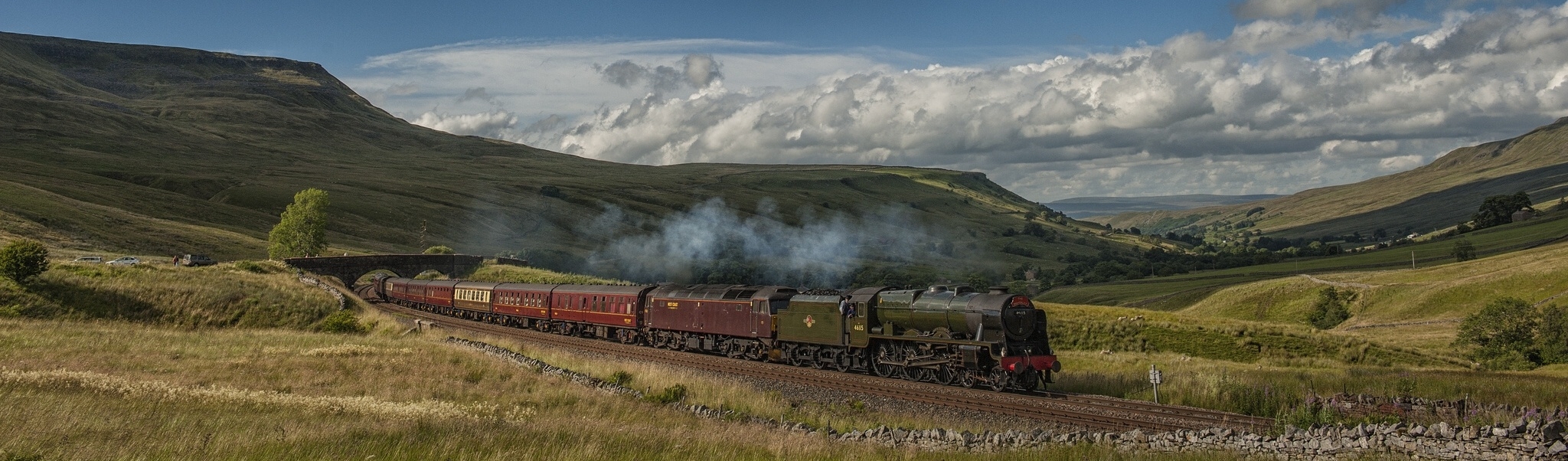



Great Western Railway class 6000 “King”

Charles Benjamin Collett, GWR's chief engineer since 1922, soon had the task of developing a more powerful express locomotive than the Castle class of its predecessor Churchward. The goal was to achieve a starting tractive effort of 40,000 pounds, despite the high speeds. First, the question of the ideal wheel arrangement had to be examined.
While the Pacific had long established itself as the ultimate express locomotive on the European mainland, the ten-wheeler remained largely the choice in Great Britain. Although the GWR had already built a single Pacific in 1908 with “The Great Bear”, this design was considered prone to slipping. After all, only half of the axles on the Pacific were powered, compared to 60 percent on the Ten-wheeler. So the choice fell again on a ten-wheeler, but with an axle load of 22 and a half tons.
Much of the power increase over the Castle class was achieved by increasing the boiler pressure to 250 psi. The boiler was introduced as GWR standard design no. 12, but only used on the King class. With a tube length of only 16 feet, it no longer reached the excessive length of “The Great Bear” and was able to achieve greater power using high quality coal from South Wales.
In addition, the stroke of the four cylinders has been increased by two inches and the diameter of the driving wheels has been reduced by 2.5 inches to a still adequate 6 feet 6 inches. Since the required 40,000 pounds of starting tractive effort could not quite be achieved, the cylinder diameter was increased again by a quarter of an inch.
Initially, the new class was to be named after cathedrals. However, when number 6000 was brought to the United States for the Baltimore & Ohio Jubilee celebrations in 1927, it was christened “King George V” after the current regent. As a result, all other locomotives were named after British kings. After a total of 20 production locomotives which had been manufactured in 1927 and 1928, another ten followed in 1930. After No. 6007 “King William III” was destroyed in an accident in 1936, a new one of the same number and name was built using some of the parts which were still intact.
The King class was used in front of the main express trains of the GWR, which ran west towards Cornwall and sometimes consisted of more than 13 coaches. A second locomotive only had to help on the steep inclines in Devon. From Plymouth, however, another locomotive had to be used for the rest of the line through Cornwall, since the axle load of the King class was too high for the Royal Albert Bridge. It also turned out that the outside cylinders with a diameter of 16.25 inches were too wide for the loading gauge in some places, so that they later had to be converted to 16 inches.
Later modifications to these locomotives were only carried out on a small scale. For example, in 1935, 6014 “King Henry VII” was partially streamlined. Only the superheaters were replaced by a different design from 1947 onwards. When the locomotives were distributed to other parts of the country when British Railways was founded in 1948, it turned out that they showed a noticeable loss of power elsewhere with lower quality coal. At the end of the 1950s they were still equipped with a double chimney, but they got all withdrawn by 1962.
Technical data
General
| Property | as built | rebuilt |
|---|---|---|
| Built | 1927-1928, 1930, 1936 | |
| Manufacturers | Swindon | |
| Wheel arrangement | 4-6-0 (Ten-wheeler) | |
| Gauge | 1,435 mm (Standard gauge) | |
Dimensions and weights
| Property | as built | rebuilt |
|---|---|---|
| Length | 20.78 m | |
| Wheelbase | 8.97 m | |
| Total wheelbase | 17.51 m | |
| Service mass | 90.4 t | |
| Adhesion mass | 68.6 t | |
| Total mass | 137.9 t | |
| Rigid wheelbase | 4.95 m | |
| Axle load | 22.9 t | |
| Water capacity | 18,185 l | |
| Fuel capacity | 6.1 t (coal) | |
Boiler
| Property | as built | rebuilt |
|---|---|---|
| Grate area | 3.187 m² | |
| Firebox surface | 17.977 m² | 18.116 m² |
| Tube heating surface | 186.596 m² | 168.898 m² |
| Evaporative heating surface | 204.573 m² | 187.014 m² |
| Superheater surface | 29.079 m² | 45.43 m² |
| Total heating surface | 233.7 m² | 232.4 m² |
Power plant
| Property | as built | rebuilt |
|---|---|---|
| Driver diameter | 1,981 mm | |
| Boiler pressure | 17.2 bar | |
| Expansion type | simple expansion | |
| Cylinders | four, 413 x 711 mm | four, 406 x 711 mm |
Power
| Property | as built | rebuilt |
|---|---|---|
| Power source | steam | |
| Estimated power | 1,566 kW (2,129 PS) | 1,641 kW (2,231 PS) |
| Starting effort | 179.2 kN | 173.7 kN |
Calculated values
| Property | as built | rebuilt |
|---|---|---|
| Factor of adhesion | 1 : 3.75 | 1 : 3.87 |
| Optimal speed | 53 km/h | 58 km/h |
| Power-to-weight ratio | 17.3 kW/t | 18.1 kW/t |
| Heating Surface Equivalent | 352.6 m² | 368.5 m² |
| Cylinder volume/HSE | 1 : 1,079.48 | 1 : 1,001.53 |
| Adhesive weight/Total | 1 : 1.32 | |
| Tractive force/Heating surface | 1 : 16.02 | 1 : 15.61 |
| Grate area/Heating surface | 1 : 73.31 | 1 : 72.94 |
| Firebox/Tube surface | 1 : 10.38 | 1 : 9.32 |
| Total/Superheater | 1 : 7.04 | 1 : 4.12 |