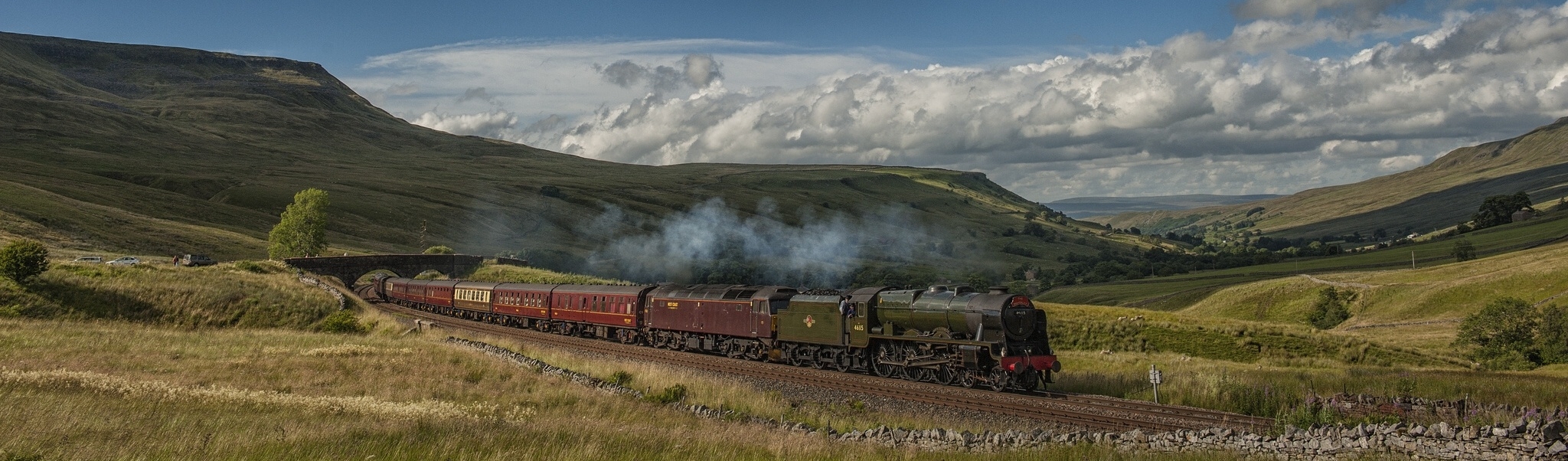



London, Brighton & South Coast class K

Around 1910, the LB&SCR needed a new locomotive for express goods trains because the old, rebuilt 0-6-0 locomotives were no longer sufficient. As there were many fast passenger trains on the LB&SCR network and the electrification of suburban lines in London was also being conceived, there were special requirements. On the one hand, the trains had to be accelerated quickly out of the sidings, but they also had to continue at high line speeds in order not to slow down passenger traffic. In addition, the new locomotive was to be fitted with train heating in order to be able to assist with heavy passenger trains during the holiday season.
The result was the class K, designed by Lawson Butzkopfski Billinton with a 2-6-0 wheel arrangement. It was an innovative design that was both the first locomotive with this wheel arrangement for the LB&SCR and the first with a Belpaire firebox. It also received a Robinson superheater, the largest tender available and other modern equipment. Ten were delivered in 1913. These were used extensively during World War I to transport ammunition, equipment and troops to ports. Typically, trains of 1,000 long tons were hauled at speeds between 30 and 35 mph.
After the war, the initial plan was to design a tank locomotive with a 2-6-2T wheel arrangement. However, since this would not be able to carry sufficient supplies, ten more of the K were ordered instead. Due to the workload of the workshops at Brighton, however, only seven were delivered. After the grouping in 1923, the class K initially provided other important services for the Southern Railway on the former LB&SCR network. During this time, various improvements were tested on the locomotives, but none of these would have brought sufficient benefits in daily work.
This changed in 1933 with the electrification of the Brighton Main Line because the locomotives had now become a traffic obstruction here. In order to be able to use them on other lines, they first had to be adapted to the smaller loading gauge elsewhere. To accomplish this, the height of the chimney, steam dome and cab roof was reduced between 1929 and 1939. After performing the same duties in World War II as in World War I, they continued to be used by British Railways and were all withdrawn in November and December 1962. In the extremely harsh winter that followed, at least one engine was taken out of storage to help keep operations going.
Technical data
General
- Built
- 1913-1921
- Manufacturers
- Brighton
- Wheel arrangement
- 2-6-0 (Mogul)
- Gauge
- 1,435 mm (Standard gauge)
Dimensions and weights
- Length
- 17.63 m
- Wheelbase
- 7.24 m
- Total wheelbase
- 14.61 m
- Service mass
- 64.5 t
- Adhesion mass
- 56.4 t
- Total mass
- 106.7 t
- Rigid wheelbase
- 4.72 m
- Axle load
- 20.1 t
- Water capacity
- 17,913 l
- Fuel capacity
- 4.1 t (coal)
Boiler
- Grate area
- 2.304 m²
- Firebox surface
- 12.914 m²
- Tube heating surface
- 107.396 m²
- Evaporative heating surface
- 120.31 m²
- Superheater surface
- 25.92 m²
- Total heating surface
- 146.2 m²
Power plant
- Driver diameter
- 1,676 mm
- Boiler pressure
- 11.7 bar
- Expansion type
- simple expansion
- Cylinders
- two, 533 x 660 mm
Power
- Power source
- steam
- Estimated power
- 783 kW (1,065 PS)
- Starting effort
- 111.7 kN
Calculated values
- Factor of adhesion
- 1 : 4.95
- Optimal speed
- 43 km/h
- Power-to-weight ratio
- 12.1 kW/t
- Heating Surface Equivalent
- 236.7 m²
- Cylinder volume/HSE
- 1 : 1,246.80
- Adhesive weight/Total
- 1 : 1.14
- Tractive force/Heating surface
- 1 : 15.95
- Grate area/Heating surface
- 1 : 63.47
- Firebox/Tube surface
- 1 : 8.32
- Total/Superheater
- 1 : 4.64