


German Reichsbahn class 95
Prussian T 20
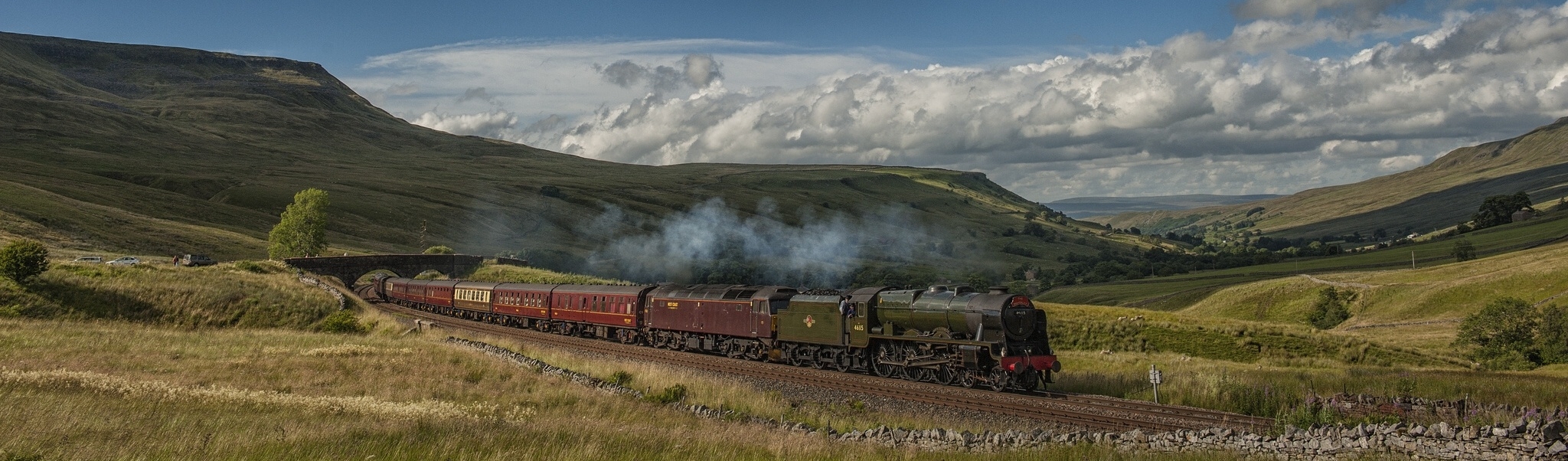
The class 95 was one of the heaviest and most powerful tank locomotives that the Deutsche Reichsbahn procured in its history. Since it was originally ordered by the Prussian State Railways as the T 20, it can often be found under this designation. The first ten were initially listed as class 77 until 1926 and only then reclassified as class 95. It was developed to haul heavy freight trains on main lines with many gradients and to convert lines with rack operation to adhesion operation.
In order to be able to provide enough traction on the inclines, a very heavy and powerful boiler was placed on a chassis with a 2-10-2T wheel arrangement. This resulted in an adhesive weight that was greater than that of most ten-coupled tender locomotives. Since the steep stretches often had tight curve radii, both carrying axles were combined with the respective outer set of driving wheels to form a Krauss-Helmholtz bogie. The remaining axles could not be moved sideways, but the wheel flanges of the middle driving wheel set were made thinner. Thanks to the additional Riggenbach-type counter-pressure brake, it was possible to brake on steep gradients without wearing out or heating up the wheel tyres. For the first time, gradients of up to seven percent could be overcome without a rack with a few cars.
The locomotive was able to haul trains weighing 430 tonnes at 25 km/h on gradients of 2.5 percent, which was almost as good as the performance of the sixteen-coupled Bavarian Gt 2x4/4. In tests on the level, a little more than 2,000 tonnes could be pulled at 50 km/h, but in reality this was reserved for the heavy tender locomotives.
All of the 45 locomotives built survived the war. Only 14 of these made it to the Bundesbahn, which made them a minor class. In the beginning they were partly used as pusher locomotives on ramps, but the last of them was already retired in 1958. The 31 vehicles of the Reichsbahn were used on the low mountain range as powerful drought horses which were indispensable for a long time. 24 of these were converted to oil firing between the late sixties and early seventies and designated class 9500. The rest became class 9510. Their service life ended in 1981 on the Sonneberg-Eisfeld route.
Technical data
General
- Built
- 1922-1924
- Manufacturers
- Borsig, Hanomag
- Wheel arrangement
- 2-10-2T (Santa Fé)
- Gauge
- 1,435 mm (Standard gauge)
Dimensions and weights
- Length
- 15.10 m
- Wheelbase
- 11.90 m
- Empty mass
- 103.7 t
- Service mass
- 127.4 t
- Adhesion mass
- 95.3 t
- Rigid wheelbase
- 3.30 m
- Axle load
- 19.5 t
- Water capacity
- 12,000 l
- Fuel capacity
- 4 t (coal)
Boiler
- Grate area
- 4.37 m²
- Firebox surface
- 17 m²
- Tube heating surface
- 182.8 m²
- Evaporative heating surface
- 199.8 m²
- Superheater surface
- 62.5 m²
- Total heating surface
- 262.3 m²
Power plant
- Driver diameter
- 1,400 mm
- Boiler pressure
- 14 bar
- Expansion type
- simple expansion
- Cylinders
- two, 700 x 660 mm
Power
- Power source
- steam
- Indicated power
- 1,192 kW (1,621 PS)
- Top speed
- 65 km/h
- Starting effort
- 274.9 kN
Calculated values
- Factor of adhesion
- 1 : 3.40
- Optimal speed
- 26 km/h
- Power-to-weight ratio
- 9.4 kW/t
- Heating Surface Equivalent
- 409.8 m²
- Cylinder volume/HSE
- 1 : 1,239.62
- Adhesive weight/Total
- 1 : 1.34
- Tractive force/Heating surface
- 1 : 21.89
- Grate area/Heating surface
- 1 : 60.02
- Firebox/Tube surface
- 1 : 10.75
- Total/Superheater
- 1 : 3.20