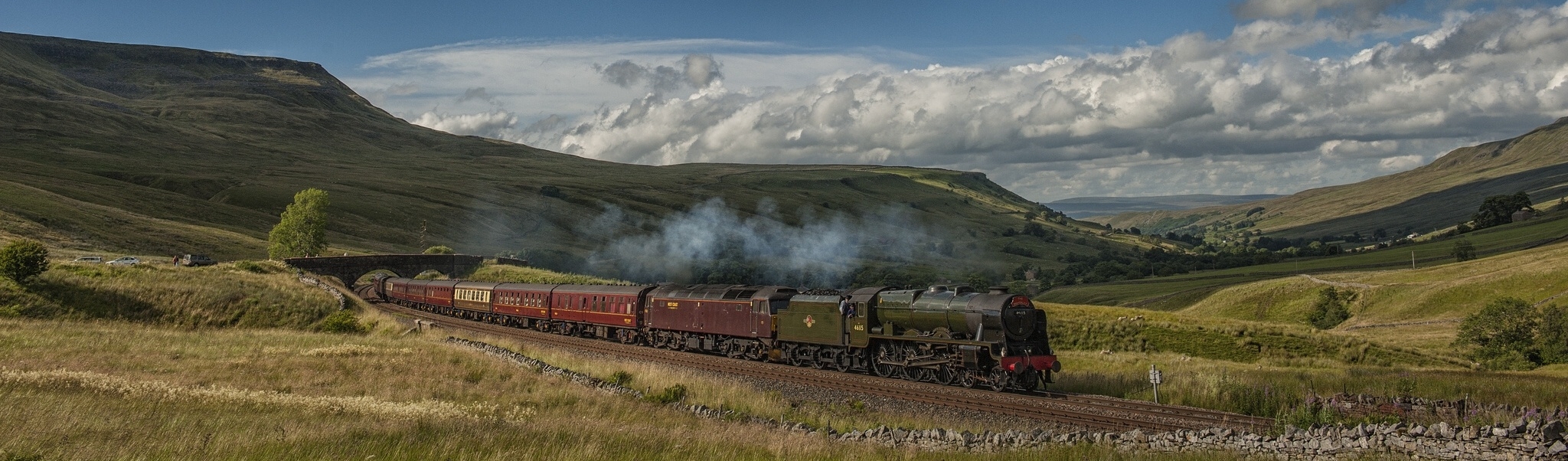



Hocking Valley class M-1
Chesapeake & Ohio class K
Shortly after the C&O had gained control over the Hocking Valley Railway, they ordered new Mikados for them which were similar to their own class K-1. ALCO-Richmond delivered numbers 180 to 184 in 1912, followed by 185 to 190 in 1913. They had oversquare cylinders with a diameter of 29 inches and a stroke of only 28 inches. At 56 inches, the driver diameter was one inch smaller than that of the C&O locomotives. The boiler was originally pressed to 170 psi, what was later increased to 185 psi.
When the Hocking Valley was completely incorporated into the C&O in 1930, these locomotives became class K No. 1089 to 1099. Some documents even counted them as class K-1, as they had many similarities with the original class K-1.
Technical data
General
- Built
- 1912-1913
- Manufacturers
- ALCO
- Wheel arrangement
- 2-8-2 (Mikado)
- Gauge
- 1,435 mm (Standard gauge)
Dimensions and weights
- Length
- 22.90 m
- Wheelbase
- 10.62 m
- Total wheelbase
- 20.54 m
- Service mass
- 146.3 t
- Adhesion mass
- 110.9 t
- Total mass
- 222.9 t
- Rigid wheelbase
- 5.03 m
- Water capacity
- 34,069 l
- Fuel capacity
- 13.6 t (coal)
Boiler
- Grate area
- 6.132 m²
- Firebox surface
- 26.292 m²
- Tube heating surface
- 350.059 m²
- Evaporative heating surface
- 376.351 m²
- Superheater surface
- 78.503 m²
- Total heating surface
- 454.9 m²
Power plant
- Driver diameter
- 1,422 mm
- Boiler pressure
- 11.7 bar
- Expansion type
- simple expansion
- Cylinders
- two, 737 x 711 mm
Power
- Power source
- steam
- Estimated power
- 1,976 kW (2,687 PS)
- Starting effort
- 270.3 kN
Calculated values
- Factor of adhesion
- 1 : 4.03
- Optimal speed
- 45 km/h
- Power-to-weight ratio
- 13.5 kW/t
- Heating Surface Equivalent
- 664.8 m²
- Cylinder volume/HSE
- 1 : 911.74
- Adhesive weight/Total
- 1 : 1.32
- Tractive force/Heating surface
- 1 : 12.41
- Grate area/Heating surface
- 1 : 74.18
- Firebox/Tube surface
- 1 : 13.31
- Total/Superheater
- 1 : 4.79