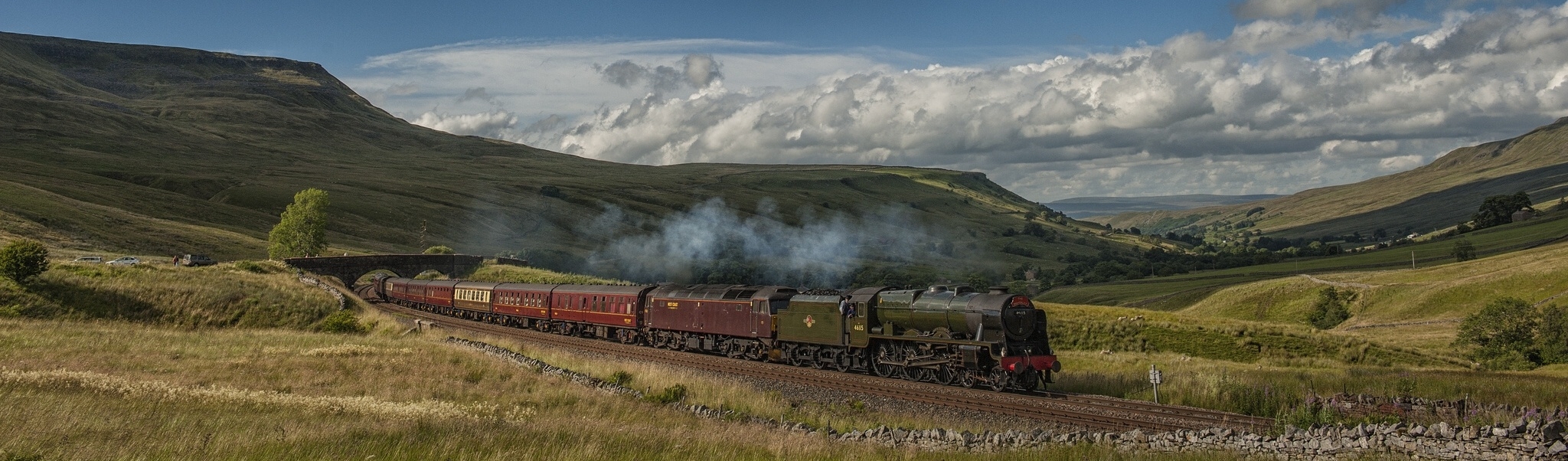



British Rail class 47 and Brush Traction type 4
originally D1500
Great Britain 1962 512 produced

The class 47 was produced in large numbers from 1962 to replace the last steam locomotives and therefore had to have an axle load of less than 20 tons. It was powered by a Sulzer twelve-cylinder engine with two cylinder banks. The initial 2,750 hp was soon reduced to 2,580 hp to improve reliability. Initially, most of the locomotives were given steam boilers, which were later replaced with electric train heating. This resulted in a large number of sub-variants that are used for passenger and freight trains and have a maximum speed of 75, 95 or 100 mph. A total of 33 locomotives were rebuilt to the class 57 from 1998. The number of locomotives in use that have not been rebuilt has now fallen significantly.
Technical data
General
| Property | as built | reduced power | 47/4 |
|---|---|---|---|
| Built | 1962-1968 | 1979-1980 | |
| Manufacturers | Brush Traction, Crewe | ||
| Wheel arrangement | C-C | ||
| Gauge | 1,435 mm (Standard gauge) | ||
Dimensions and weights
| Property | as built | reduced power | 47/4 |
|---|---|---|---|
| Length | 19.38 m | ||
| Wheelbase | 15.70 m | ||
| Service mass | 119.9 t | ||
| Adhesion mass | 119.9 t | ||
| Axle load | 20 t | ||
Power plant
| Property | as built | reduced power | 47/4 |
|---|---|---|---|
| Engine | Sulzer 12LDA28-C | ||
| Engine type | 12-cyl. diesel | ||
Power
| Property | as built | reduced power | 47/4 |
|---|---|---|---|
| Power source | diesel-electric | ||
| Indicated power | 2,051 kW (2,789 PS) | 1,924 kW (2,616 PS) | |
| Top speed | 121 km/h | 153 km/h | |
| Starting effort | 266.9 kN | 244.7 kN | |
Calculated values
| Property | as built | reduced power | 47/4 |
|---|---|---|---|
| Factor of adhesion | 1 : 4.41 | 1 : 4.81 | |
| Power-to-weight ratio | 17.1 kW/t | 16.0 kW/t | |
| Adhesive weight/Total | 1 : 1.00 | ||