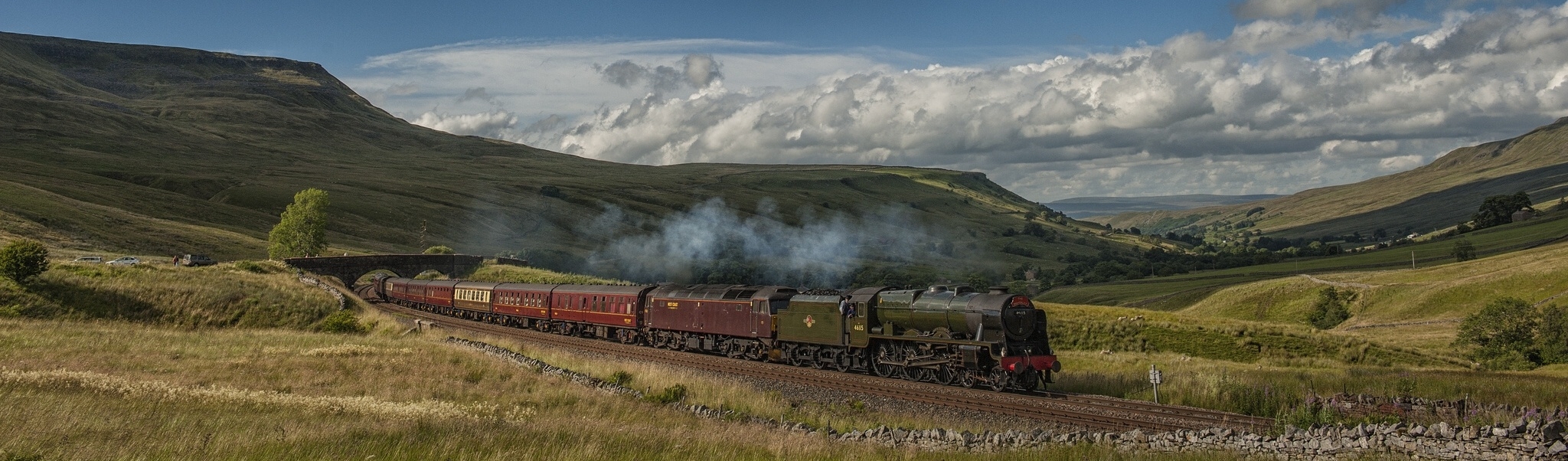



Missouri Pacific class P-69
While the first 4-6-2 locomotives still had a narrow firebox and did not bring much advantage over the 4-6-0, the later, classic Pacifics were characterized by a wide firebox above the trailing axle. This allowed a sufficiently large grate area to maintain high speeds with heavy trains, as had been the case with the Atlantic-type express locomotives a few years earlier. While the Pacific was used almost exclusively as express locomotive in Europe, there were also many locomotives in North America with slightly smaller drivers, which were primarily intended for the heaviest, more medium-speed passenger trains.
The first model of this type were the 21 Missouri Pacific locomotives, which were built by ALCO-Brooks in 1902 and formed the basis for the name “Pacific”. They were lighter than other Pacifics which were built in the following years and had a driver diameter of only 69 inches. Together with the abbreviation "P" for “Pacific”, this led to the class designation P-69.
Since the locomotives were partly built directly for the Missouri Pacific and partly for their subsidiary St. Louis, Iron Mountain and Southern Railway, they were given separate number ranges between 1115 and 1123 and between 1616 and 1623. The Stephenson valve gear was later replaced on 20 locomotives by a Baker valve gear and on one locomotive by the Walschaerts valve gear. In 1916 they were superheated, where the cylinder diameter was increased by one inch. The last ones served in this form until 1953.
Technical data
General
| Property | as built | superheated |
|---|---|---|
| Built | 1902 | 1916 |
| Manufacturers | ALCO | Missouri Pacific |
| Wheel arrangement | 4-6-2 (Pacific) | |
| Gauge | 1,435 mm (Standard gauge) | |
Dimensions and weights
| Property | as built | superheated |
|---|---|---|
| Wheelbase | 9.27 m | 9.65 m |
| Total wheelbase | 16.80 m | 16.82 m |
| Service mass | 78.5 t | 87.5 t |
| Adhesion mass | 54.4 t | 56.2 t |
| Total mass | 128.4 t | 154.9 t |
| Rigid wheelbase | 3.76 m | |
| Axle load | 18.1 t | 18.7 t |
| Water capacity | 18,927 l | 26,498 l |
| Fuel capacity | 9.1 t (coal) | 12.7 t (coal) |
Boiler
| Property | as built | superheated |
|---|---|---|
| Grate area | 3.939 m² | |
| Firebox surface | 16.165 m² | 20.532 m² |
| Tube heating surface | 258.178 m² | 195.189 m² |
| Evaporative heating surface | 274.343 m² | 215.721 m² |
| Total heating surface | 274.3 m² | 255.7 m² |
| Superheater surface | 39.948 m² | |
Power plant
| Property | as built | superheated |
|---|---|---|
| Driver diameter | 1,753 mm | |
| Boiler pressure | 13.8 bar | |
| Expansion type | simple expansion | |
| Cylinders | two, 508 x 660 mm | two, 533 x 660 mm |
Power
| Property | as built | superheated |
|---|---|---|
| Power source | steam | |
| Estimated power | 1,119 kW (1,521 PS) | |
| Starting effort | 114.0 kN | 125.7 kN |
Calculated values
| Property | as built | superheated |
|---|---|---|
| Factor of adhesion | 1 : 4.68 | 1 : 4.39 |
| Optimal speed | 60 km/h | 55 km/h |
| Power-to-weight ratio | 14.3 kW/t | 12.8 kW/t |
| Heating Surface Equivalent | 355.2 m² | 398.3 m² |
| Cylinder volume/HSE | 1 : 753.74 | 1 : 741.05 |
| Adhesive weight/Total | 1 : 1.44 | 1 : 1.56 |
| Tractive force/Heating surface | 1 : 8.68 | 1 : 10.27 |
| Grate area/Heating surface | 1 : 69.65 | 1 : 64.91 |
| Firebox/Tube surface | 1 : 15.97 | 1 : 9.51 |
| Total/Superheater | 1 : 5.40 |