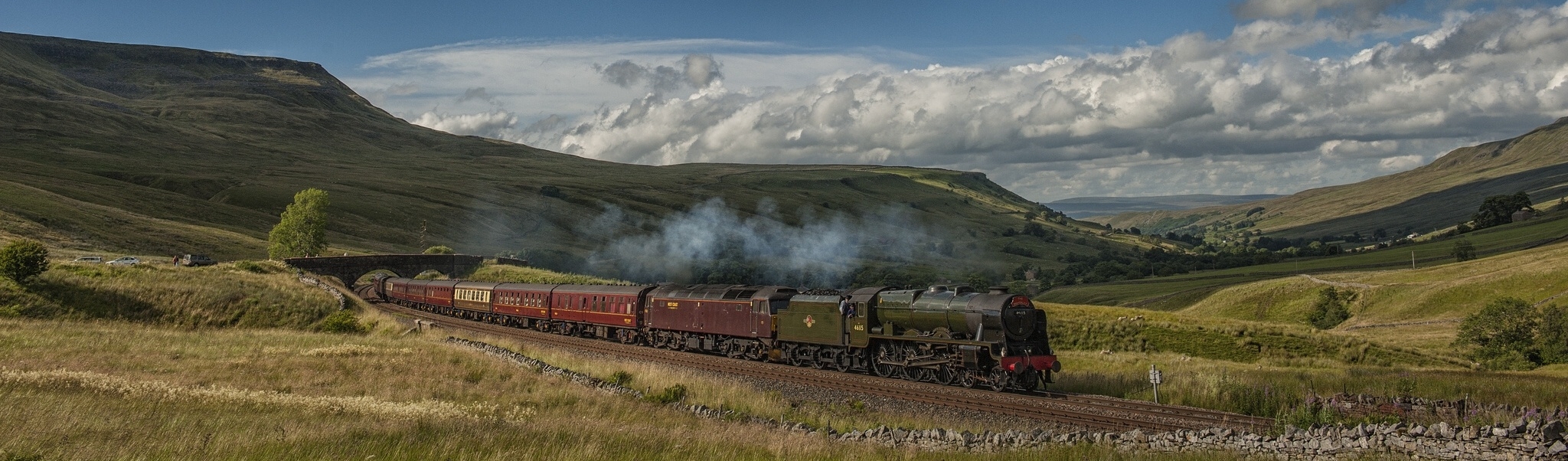



Wabash class J-2
In 1912, the Wabash had procured the last new passenger locomotives with the 16 class J-1 Pacifics. In 1916, a class G-1 locomotive with a 2-6-2 wheel arrangement was taken instead and converted into a 4-6-2. The G-2 was particularly suitable because it already had 70-inch wheels and was less than ten years old. The locomotive was lengthened by about four feet and the leading axle was replaced with a bogie.
Since the conversion was successful, another 22 of the total of 60 engines of the G-1 class were converted in this form. Some of these had received the numbers between 1676 and 1681 and were used between New York and Ontario, the others carried the numbers from 683 to 699 and remained entirely in the USA. The first of these was retired in January 1947 and the last in February 1952.
Technical data
General
- Built
- 1916-1926
- Manufacturers
- Wabash Railroad
- Wheel arrangement
- 4-6-2 (Pacific)
- Gauge
- 1,435 mm (Standard gauge)
Dimensions and weights
- Wheelbase
- 10.47 m
- Total wheelbase
- 19.71 m
- Service mass
- 109.3 t
- Adhesion mass
- 68.7 t
- Total mass
- 178.7 t
- Rigid wheelbase
- 4.06 m
- Axle load
- 24 t
- Water capacity
- 22,712 l
- Fuel capacity
- 9.1 t (coal)
Boiler
- Grate area
- 5.04 m²
- Firebox surface
- 20.253 m²
- Tube heating surface
- 273.786 m²
- Evaporative heating surface
- 294.038 m²
- Superheater surface
- 68.748 m²
- Total heating surface
- 362.8 m²
Power plant
- Driver diameter
- 1,778 mm
- Boiler pressure
- 13.8 bar
- Expansion type
- simple expansion
- Cylinders
- two, 572 x 711 mm
Power
- Power source
- steam
- Estimated power
- 1,473 kW (2,003 PS)
- Starting effort
- 153.1 kN
Calculated values
- Factor of adhesion
- 1 : 4.40
- Optimal speed
- 60 km/h
- Power-to-weight ratio
- 13.5 kW/t
- Heating Surface Equivalent
- 532.8 m²
- Cylinder volume/HSE
- 1 : 684.83
- Adhesive weight/Total
- 1 : 1.59
- Tractive force/Heating surface
- 1 : 8.82
- Grate area/Heating surface
- 1 : 71.98
- Firebox/Tube surface
- 1 : 13.52
- Total/Superheater
- 1 : 4.28