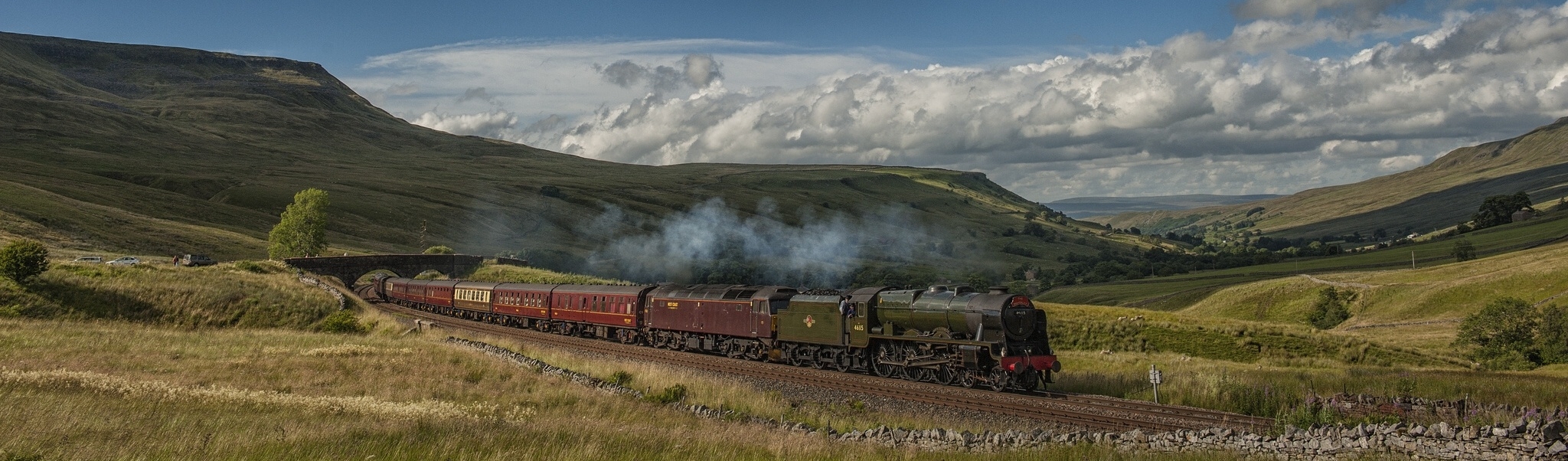



London, Midland & Scottish Fairburn 4P 2-6-4T
Great Britain 1945 277 produced

In his short career as Chief Mechanical Engineer at the LMS, Charles Fairburn designed only one steam locomotive. This was a direct development of Stanier's 2-6-4T, having a shorter rigid wheelbase to be able to negotiate tighter curves. This also led to a weight that was 3 tons 8 cwt lighter.
236 were built for the LMS and BR at Derby between 1945 and 1950. In 1950 and 1951, 41 more were built at Brighton for the Southern Region. They also formed the basis for the BR Standard class 4 tank. Withdrawals took place between 1961 and 1967 and two are surviving at the Lakeside and Haverthwaite Railway. As of 2024, 42073 is operational and 42085 is being overhauled.
Technical data
General
- Built
- 1945-1951
- Manufacturers
- Derby, Brighton
- Wheel arrangement
- 2-6-4T (Adriatic)
- Gauge
- 1,435 mm (Standard gauge)
Dimensions and weights
- Length
- 13.96 m
- Wheelbase
- 11.30 m
- Service mass
- 86.6 t
- Adhesion mass
- 53.9 t
- Rigid wheelbase
- 4.67 m
- Axle load
- 18.2 t
- Water capacity
- 9,093 l
- Fuel capacity
- 3.6 t (coal)
Boiler
- Grate area
- 2.481 m²
- Firebox surface
- 13.285 m²
- Tube heating surface
- 113.621 m²
- Evaporative heating surface
- 126.906 m²
- Superheater surface
- 21.368 m²
- Total heating surface
- 148.3 m²
Power plant
- Driver diameter
- 1,753 mm
- Boiler pressure
- 13.8 bar
- Expansion type
- simple expansion
- Cylinders
- two, 498 x 660 mm
Power
- Power source
- steam
- Estimated power
- 969 kW (1,317 PS)
- Starting effort
- 109.7 kN
Calculated values
- Factor of adhesion
- 1 : 4.81
- Optimal speed
- 55 km/h
- Power-to-weight ratio
- 11.2 kW/t
- Heating Surface Equivalent
- 236.1 m²
- Cylinder volume/HSE
- 1 : 1,091.89
- Adhesive weight/Total
- 1 : 1.61
- Tractive force/Heating surface
- 1 : 15.46
- Grate area/Heating surface
- 1 : 59.76
- Firebox/Tube surface
- 1 : 8.55
- Total/Superheater
- 1 : 5.94