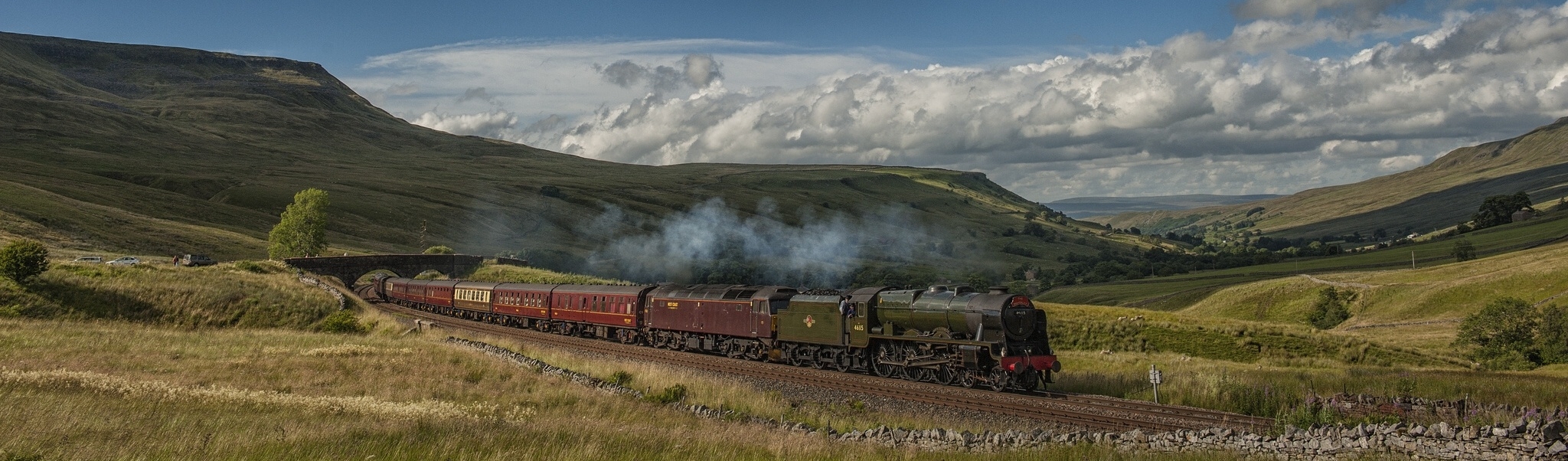



Austrian Southern Railway class 109
Austrian Federal Railways (BBÖ) class 209, Hungarian State Railways classes 302.5 and 302.6, Yugoslav Railway class 03, Italian State Railway class 653, and German Reichsbahn class 3841

The class 109 of the Südbahn was created in 1910 when a more powerful successor of the class 32f 4-6-0 express locomotive was needed. The requirements included a top speed of 90 km/h, suitability for curves of 150 meters, a maximum axle load of 14.4 tonnes and enough power to haul a train weighing 320 tonnes including locomotive and tender up an 1.25 percent incline at 40 km/h. This required a grate area of around 3.5 square meters.
To achieve the needed grate area, the firebox had to be made wide, what necessitated a boiler that was high enough above the driving wheels. These had a diameter of 1,740 mm. Between 1910 and 1914, 44 were built by the StEG factory, Floridsdorf and Wiener Neustadt. Later, a variant called class 109.1 was built for Hungarian lines. Seven of this were built in 1913 by MÁVAG and two more in 1917 by Floridsdorf.
After World War I, 17 stayed in Austria and when the Südbahn was nationalized in 1923, they became BBÖ class 209. Ten had become MÁV class 302.6, which were joined by four heavier ones built between 1927 and 1930 which were designated class 302.5. 13 came to the SHS state and later Yugoslavia and became JDŽ class 03. Also 13 came to Italy and became FS class 653.
In 1938, the 17 BBÖ locomotives became Reichsbahn class 3841, joined by the 13 Yugoslavian ones in World War II. After the War, the BBÖ continued to use the class number 38. Seven were equipped with a Giesl ejector, increasing their power considerably. Depending on the country of service, they were withdrawn between 1962 and 1968. Today three are preserved, with one each operational in Austria and Hungary.
Technical data
General
- Built
- 1910-1914, 1927-1930
- Manufacturers
- StEG, Floridsdorf, Wiener Neustadt
- Wheel arrangement
- 4-6-0 (Ten-wheeler)
- Gauge
- 1,435 mm (Standard gauge)
Dimensions and weights
- Length
- 17.53 m
- Length loco
- 13.35 m
- Wheelbase
- 8.19 m
- Total wheelbase
- 14.09 m
- Empty mass
- 59.6 t
- Service mass
- 66.9 t
- Adhesion mass
- 43.2 t
- Total mass
- 107.9 t
- Rigid wheelbase
- 4.15 m
- Axle load
- 14.4 t
- Water capacity
- 17,000 l
- Fuel capacity
- 6 t (coal)
Boiler
- Grate area
- 3.55 m²
- Firebox surface
- 12 m²
- Tube heating surface
- 173.8 m²
- Evaporative heating surface
- 185.8 m²
- Superheater surface
- 51.9 m²
- Total heating surface
- 237.7 m²
Power plant
- Driver diameter
- 1,740 mm
- Boiler pressure
- 13 bar
- Expansion type
- simple expansion
- Cylinders
- two, 550 x 650 mm
Power
- Power source
- steam
- Indicated power
- 1,140 kW (1,550 PS)
- Top speed
- 90 km/h
- Starting effort
- 124.9 kN
Calculated values
- Factor of adhesion
- 1 : 3.39
- Optimal speed
- 56 km/h
- Power-to-weight ratio
- 17.0 kW/t
- Heating Surface Equivalent
- 349.6 m²
- Cylinder volume/HSE
- 1 : 883.46
- Adhesive weight/Total
- 1 : 1.55
- Tractive force/Heating surface
- 1 : 10.97
- Grate area/Heating surface
- 1 : 66.96
- Firebox/Tube surface
- 1 : 14.48
- Total/Superheater
- 1 : 3.58