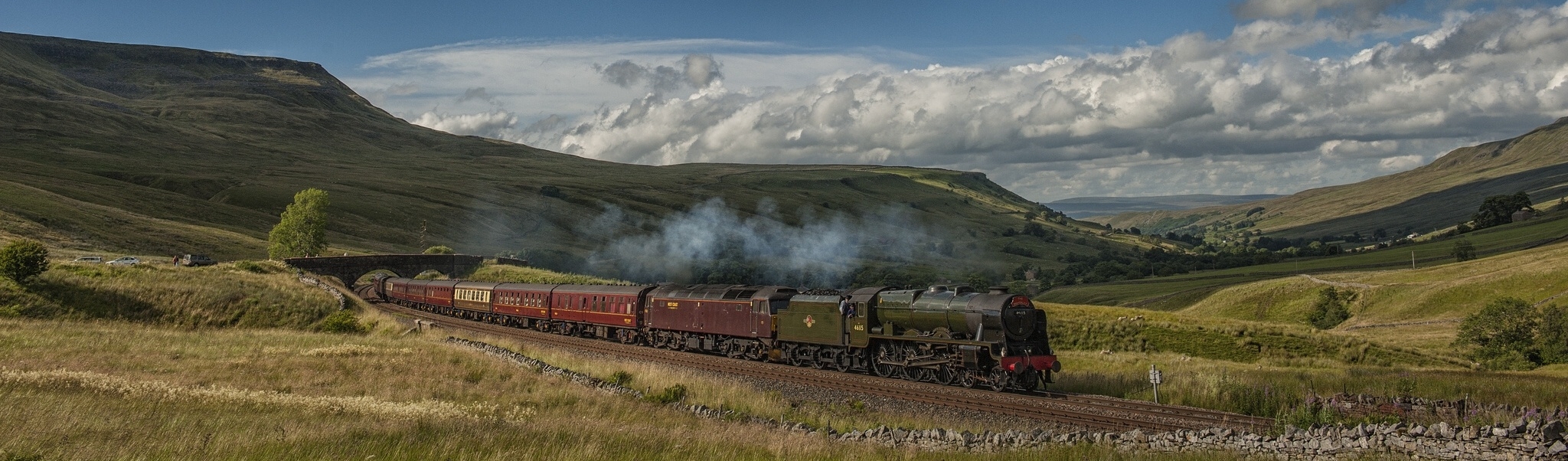
When hauling the new steel passenger cars over the Allegheny Mountains, the class F-15 Pacific locomotives quickly reached their limits, so that the trains could not consist of more than six cars. As a remedy, a new type of locomotive was designed in which, compared to the Pacific, a fourth driving axle was added and the diameter of the wheels was slightly reduced in order to obtain more adhesive weight, to be able to install a larger boiler and to increase the tractive effort. Since this was the first locomotive with a 4-8-2 wheel arrangement in North America, the C&O gave the design the name “Mountain”.
Compared to the F-15, the tractive effort was almost doubled and the indicated power significantly increased. Ten steel cars with a total weight of around 600 tons could now be hauled over the Alleghenies without any problems. With this load, they could reach 25 mph at 2.52 percent, and even 70 mph were reached on the flat. However, a disadvantage of the smaller drivers and the special design of the Walschaerts valve gear was that the engines exerted a very high hammer blow on the rails. As a result, only three class J-1 locomotives remained and from then on significantly more powerful Pacific class F-16 and F-17 locomotives were procured for the same task.
During World War I, the J-1 had to haul heavy freight trains across the Alleghenies. After the end of the war, seven examples of the USRA Heavy Mountain were procured and designated class J-2. These put less strain on the rails with larger drivers and Baker valve gear and, due to the increased boiler output, were able to generate approximately the same pulling power.
In the 1920s, the J-1's valve gear was optimized with the help of new knowledge in order to reduce the known problems. In addition, the J-2s were soon fitted with Walschaerts valve gear and were then referred to as the J-2a. Two were built new and five USRA locomotives were rebuilt. In the 1930s and 1940s they were overtaken by the new J-3 and L-2 class locomotives, which initially led to the J-1 being phased out by 1948. Shortly thereafter, the C&O passenger trains were converted to diesel traction, which also meant that the J-2 was retired by 1952.