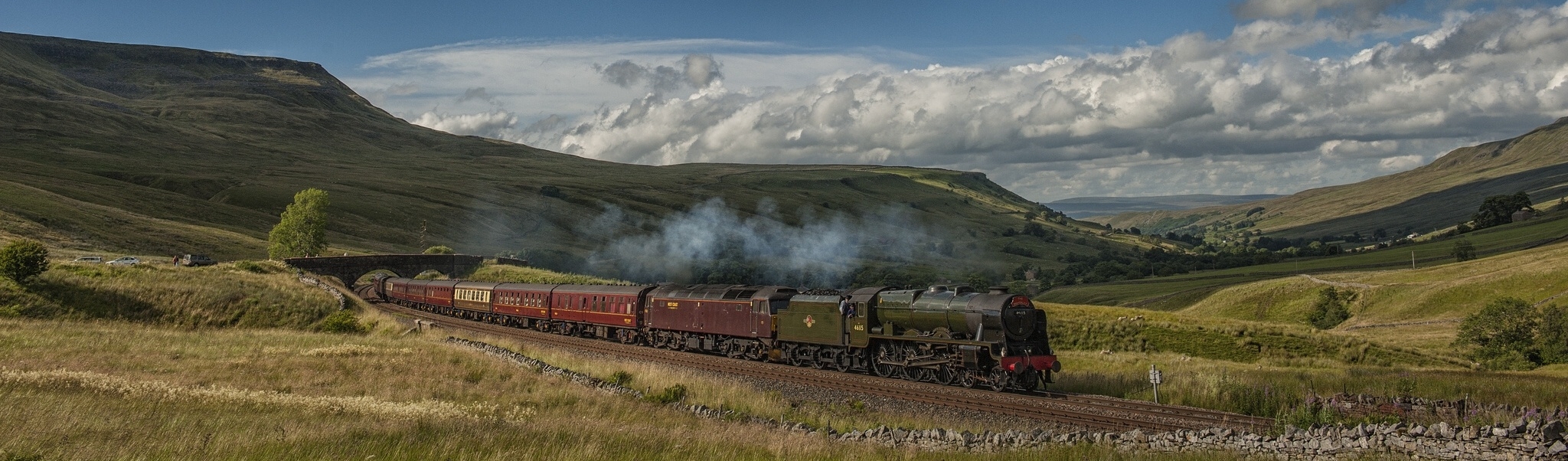



Canadian Pacific class G3

After the First World War, the Canadian Pacific realized that a significantly more powerful Pacific was needed for the new, six-axle heavyweight passenger cars. Chief engineer William H. Winterrowd then developed the class G3 with a driver diameter of 75 inches, which was intended for the flatter lines. A total of 26 of the G3a, b and c variants, which were almost identical, were completed by 1923.
In 1926, 25 of the G3d followed, the most important innovation of which was a boiler made of nickel steel. This allowed the boiler pressure to be increased from 200 psi (13.8 bars) to 250 psi (17.2 bars). Although the cylinders were made smaller at the same time, the starting tractive effort could be increased.
Twelve years later, the 27 G3e and f followed, which in turn benefited from new advances in boiler construction and now had a boiler pressure of 275 psi (19 bars). The cylinder diameter was reduced again, while the starting tractive effort remained about the same. The G3g, h and j reached the largest number with 93, which only followed in the forties and were almost identical to the series e and f in terms of the engine. However, they had a boiler with fewer tubes and were used with smaller tenders. They were real multi-purpose locomotives and were also used in front of freight trains.
Although it was precisely the later variants that came up at a time when other railways had already switched to 4-6-4 or 4-8-4, they were relatively powerful compared to other Pacifics and had a better ratio of adhesive to service weight than other locomotives and had less of a tendency to slip. Their service life ended in 1959, when there were already enough diesel locomotives for their tasks. Today only number 2317 still exists, which belongs to class G3c.
Technical data
General
| Property | G3a to c | G3d | G3e and f | G3g, h and j |
|---|---|---|---|---|
| Built | 1919-1923 | 1926 | 1938, 1940 | 1942-1945, 1948 |
| Manufacturers | Angus Shops | Montreal Locomotive Works | Canadian Locomotive Co. | Canadian Locomotive Co., Montreal Locomotive Works |
| Wheel arrangement | 4-6-2 (Pacific) | |||
| Gauge | 1,435 mm (Standard gauge) | |||
Dimensions and weights
| Property | G3a to c | G3d | G3e and f | G3g, h and j |
|---|---|---|---|---|
| Wheelbase | 10.52 m | 10.67 m | ||
| Service mass | 135.6 t | 139 t | 145.6 t | 146.5 t |
| Adhesion mass | 82.3 t | 83.4 t | 89.8 t | 90.5 t |
| Total mass | 216.4 t | 247 t | 246.3 t | 235.8 t |
| Rigid wheelbase | 4.01 m | |||
Boiler
| Property | G3a to c | G3d | G3e and f | G3g, h and j |
|---|---|---|---|---|
| Grate area | 6.039 m² | |||
| Firebox surface | 27.648 m² | 27.035 m² | ||
| Tube heating surface | 300.3 m² | 277.037 m² | 297.94 m² | 268.026 m² |
| Evaporative heating surface | 327.948 m² | 304.072 m² | 324.975 m² | 295.06 m² |
| Superheater surface | 74.601 m² | 80.268 m² | 136.846 m² | 137.032 m² |
| Total heating surface | 402.5 m² | 384.3 m² | 461.8 m² | 432.1 m² |
Power plant
| Property | G3a to c | G3d | G3e and f | G3g, h and j |
|---|---|---|---|---|
| Driver diameter | 1,905 mm | |||
| Boiler pressure | 13.8 bar | 17.2 bar | 19 bar | |
| Cylinders | two, 635 x 762 mm | two, 584 x 762 mm | two, 559 x 762 mm | |
Power
| Property | G3a to c | G3d | G3e and f | G3g, h and j |
|---|---|---|---|---|
| Estimated power | 1,864 kW (2,534 PS) | 2,163 kW (2,941 PS) | 2,834 kW (3,853 PS) | 2,759 kW (3,751 PS) |
Calculated values
| Property | G3a to c | G3d | G3e and f | G3g, h and j |
|---|---|---|---|---|
| Optimal speed | 60 km/h | 66 km/h | 87 km/h | 84 km/h |
| Power-to-weight ratio | 13.7 kW/t | 15.6 kW/t | 19.5 kW/t | 18.8 kW/t |
| Heating Surface Equivalent | 615.4 m² | 599.8 m² | 733.8 m² | 704.3 m² |
| Cylinder volume/HSE | 1 : 784.28 | 1 : 681.09 | 1 : 509.31 | 1 : 530.68 |
| Adhesive weight/Total | 1 : 1.65 | 1 : 1.67 | 1 : 1.62 | |
| Grate area/Heating surface | 1 : 66.66 | 1 : 63.64 | 1 : 76.47 | 1 : 71.55 |
| Firebox/Tube surface | 1 : 10.86 | 1 : 10.25 | 1 : 11.02 | 1 : 9.91 |
| Total/Superheater | 1 : 4.40 | 1 : 3.79 | 1 : 2.37 | 1 : 2.15 |