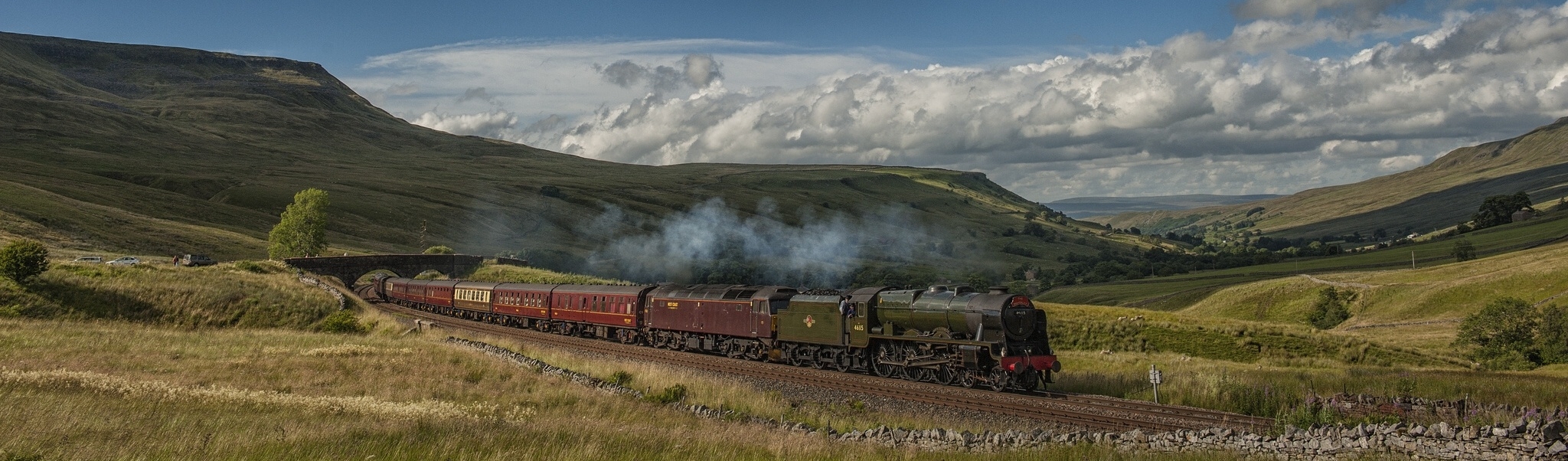



Great Northern (UK) class O1 “Tangos”
London & North Eastern class O3
The O1 was designed by Sir Nigel Gresley for the Great Northern Railway to reduce the number of heavy coal trains between Grantham and London with more powerful locomotives. So far, the classes Q1 and Q2 with the 0-8-0 wheel arrangement had been used for this task and the required larger boiler was to be made possible by means of an additional axle. Since there were many diverging points to be run over when entering London, the additional axle was added as a leading axle to improve the running characteristics. The number of four coupled axles remained the same.
Gresley derived the larger boiler from the class C1 Atlantic express locomotives that his predecessor Ivatt had developed. As with the 2-6-0 locomotives of the K1 and K2 classes, Gresley arranged the cylinders on the outside in order to be able to increase their dimensions. The very first engine showed its capabilities, hauling a train of 78 two-axle coal wagons and two 20-ton brake vans at speeds of up to 27.5 mph. Their predecessors had been limited to 60 cars.
The first five locomotives were built in Doncaster in 1914, but the second order of 15 could not be completed due to the war. However, after the end of the war, the completed parts could be taken to the North British Locomotive Company and delivered as finished locomotives in 1918 and 1919. A development of the O1 was the O2 with three cylinders. As with all GNR stock, the O1 were taken over by the LNER in 1923 and were renamed O3 in 1944, as another locomotive called the O1 by Thompson was introduced at that time. When British Railways was founded in 1948, there were still 17 examples, all of which were retired by 1952.
Technical data
General
- Built
- 1914-1919
- Manufacturers
- Doncaster, North British
- Wheel arrangement
- 2-8-0 (Consolidation)
- Gauge
- 1,435 mm (Standard gauge)
Dimensions and weights
- Length
- 18.58 m
- Wheelbase
- 8.03 m
- Total wheelbase
- 15.70 m
- Service mass
- 77.4 t
- Adhesion mass
- 68.5 t
- Total mass
- 121.2 t
- Rigid wheelbase
- 5.64 m
- Axle load
- 17.9 t
- Water capacity
- 19,094 l
- Fuel capacity
- 7.3 t (coal)
Boiler
- Grate area
- 2.508 m²
- Firebox surface
- 15.05 m²
- Tube heating surface
- 178.56 m²
- Evaporative heating surface
- 193.61 m²
- Superheater surface
- 52.955 m²
- Total heating surface
- 246.6 m²
Power plant
- Driver diameter
- 1,422 mm
- Boiler pressure
- 11.7 bar
- Expansion type
- simple expansion
- Cylinders
- two, 533 x 711 mm
Power
- Power source
- steam
- Estimated power
- 858 kW
- Starting effort
- 141.7 kN
Calculated values
- Factor of adhesion
- 1 : 4.74
- Optimal speed
- 37 km/h
- Power-to-weight ratio
- 11.1 kW/t
- Heating Surface Equivalent
- 374.8 m²
- Cylinder volume/HSE
- 1 : 848.11
- Adhesive weight/Total
- 1 : 1.13
- Tractive force/Heating surface
- 1 : 12.01
- Grate area/Heating surface
- 1 : 98.31
- Firebox/Tube surface
- 1 : 11.86
- Total/Superheater
- 1 : 3.66