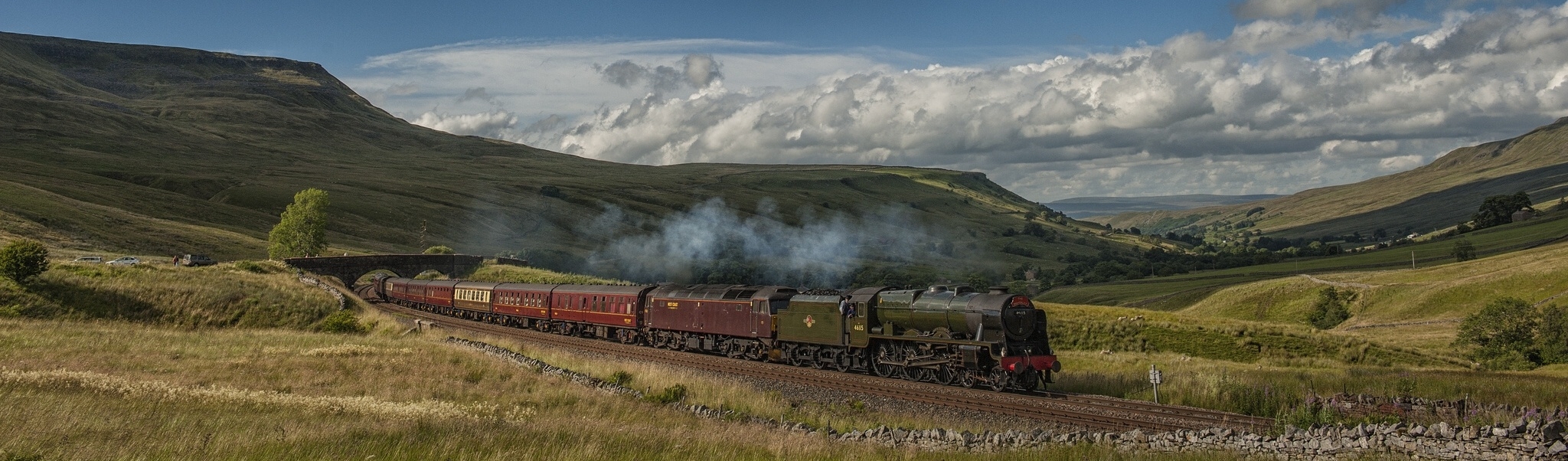



French State Railway 241 P

Although the electrification of the French main lines was already foreseeable shortly after the end of the Second World War, particularly powerful steam locomotives were needed for the transitional period. Since express trains with up to 20 four-axle coaches had to be hauled on mountainous main routes, an output of around 4,000 hp was required. The choice fell on a locomotive with a 4-8-2 wheel arrangement, which was also called the “extended Pacific” in France. The 241 P developed in this way was the last steam locomotive in Europe with this wheel arrangement.
The 241 C of the PLM from the year 1930, which had only been built once, was used as the basis. In the De Glehn four-cylinder compound powerplant, the high-pressure cylinders were located within the frame between the first and second coupled axle and drove the third coupled axle. The low-pressure cylinders were level with the middle of the bogie and drove the second coupled axle. André Chapelon was involved in optimizing the steam paths in the boiler and powerplant, but did not have the opportunity to redesign the design in depth. In addition, a double, cloverleaf-shaped blowpipe based on the PLM design and a mechanical stoker were installed.
Compared to the 241 C, the 241 P achieved about 20 percent more power. While the predecessor did not make it into series production, a total of 35 examples of the 241 P were built up to 1952. As standard they received a tender with 34 cubic meters of water and twelve tonnes of coal, but alternatively tenders with 36 cubic meters of water and only nine tonnes of coal were also used.
The engines first came to the Sud-Est and Nord regions. After the most important main lines there were electrified, some were moved to other lines within the regions and others were moved to the Est and Ouest regions. In the 1960s, they were able to prove their power one last time when they had to stand in alone to replace broken A1AA1A 68000 diesel locomotives, which were otherwise used double-headed.
In January 1969, 17 of the 35 pieces were still in use. In that year, the number of remaining engines decreased rapidly, so that the last regular operations took place on September 28, 1969. Four engines have been preserved, with number 17 being the only operational one to date, making it the most powerful operational steam engine in Europe. Number 9 could also become operational again in the future.
Technical data
General
- Built
- 1948-1952
- Manufacturers
- Schneider
- Wheel arrangement
- 4-8-2 (Mountain)
- Gauge
- 1,435 mm (Standard gauge)
Dimensions and weights
- Length
- 27.12 m
- Length loco
- 17.17 m
- Total wheelbase
- 13.46 m
- Empty mass
- 6.3 t
- Service mass
- 131.4 t
- Adhesion mass
- 81.6 t
- Total mass
- 216.2 t
- Rigid wheelbase
- 23.50 m
- Axle load
- 20.4 t
- Water capacity
- 34,000 l
- Fuel capacity
- 12 t (coal)
Boiler
- Grate area
- 5.05 m²
- Firebox surface
- 29.43 m²
- Tube heating surface
- 215.34 m²
- Evaporative heating surface
- 244.77 m²
- Superheater surface
- 108.38 m²
- Total heating surface
- 353.2 m²
Power plant
- Driver diameter
- 2,020 mm
- Boiler pressure
- 20 bar
- Expansion type
- compound
- Cylinders
- four, HP: 446 x 650 mm and LP: 674 x 700 mm
Power
- Power source
- steam
- Indicated power
- 2,940 kW (3,997 PS)
- Top speed
- 120 km/h
- Starting effort
- 154.7 kN
- Starting effort simple
- 185.7 kN
Calculated values
- Factor of adhesion
- 1 : 5.17
- Optimal speed
- 116 km/h
- Power-to-weight ratio
- 22.4 kW/t
- Heating Surface Equivalent
- 608.7 m²
- Cylinder volume/HSE
- 1 : 743.98
- Adhesive weight/Total
- 1 : 1.61
- Tractive force/Heating surface
- 1 : 9.15
- Grate area/Heating surface
- 1 : 69.93
- Firebox/Tube surface
- 1 : 7.32
- Total/Superheater
- 1 : 2.26