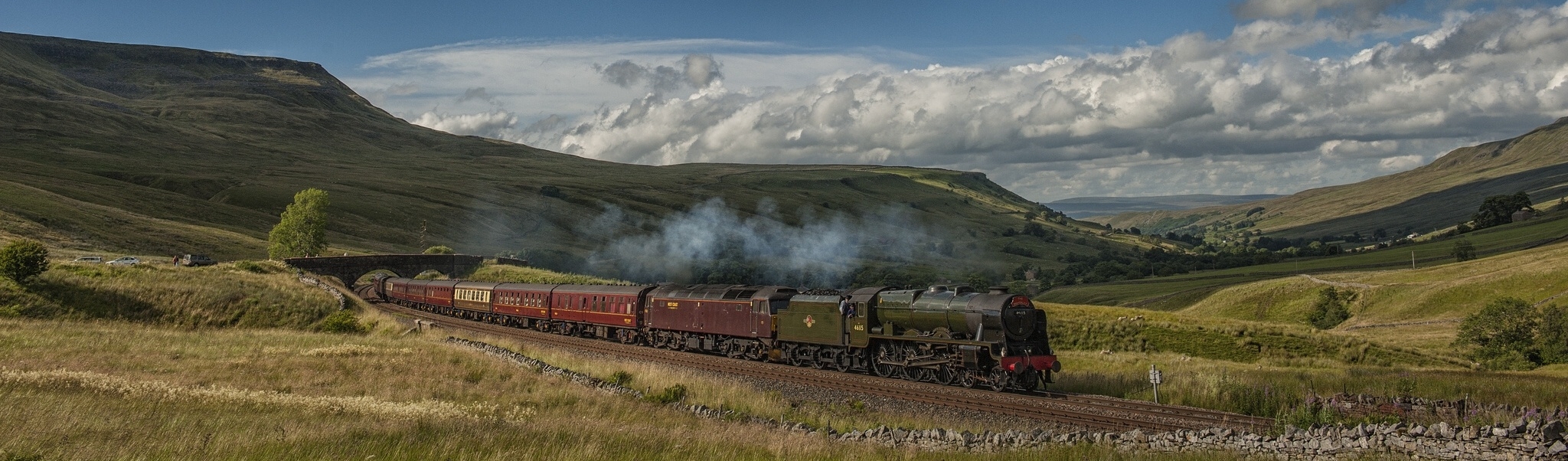




Philadelphia & Reading “Pennsylvania”
United States 1863 1 produced

The “Pennsylvania” of the Philadelphia & Reading wasn't only the biggest of the camelbacks designed by James Milholland, but also the biggest locomotive in the world when it was completed in 1863. It was a 0-12-0 that was used as pusher on the steep Falls Grade near Philadelphia, Pennsylvania.
A special feature of this locomotive was that it didn't have a separate tender, but wasn't a real tank locomotive either. This meant that it had no coal bunker and only small water tanks, but was stoked before each of the short climbs. Since it was found out that the freight cars of the time couldn't handle the forces of this massive locomotive, it was rebuilt in 1870. It now had only five axles, a tender and a new cab.
Technical data
General
- Built
- 1863
- Manufacturers
- Reading
- Wheel arrangement
- 0-12-0T (Twelve-coupled)
- Gauge
- 1,435 mm (Standard gauge)
Dimensions and weights
- Wheelbase
- 5.97 m
- Service mass
- 50 t
- Adhesion mass
- 50 t
- Rigid wheelbase
- 5.97 m
- Axle load
- 8.3 t
Boiler
- Grate area
- 2.926 m²
- Firebox surface
- 18.395 m²
- Tube heating surface
- 114.271 m²
- Evaporative heating surface
- 132.666 m²
- Total heating surface
- 132.7 m²
Power plant
- Driver diameter
- 1,092 mm
- Boiler pressure
- 6.9 bar
- Expansion type
- simple expansion
- Cylinders
- two, 508 x 660 mm
Power
- Power source
- steam
- Estimated power
- 373 kW (507 PS)
- Starting effort
- 91.4 kN
Calculated values
- Factor of adhesion
- 1 : 5.36
- Optimal speed
- 26 km/h
- Power-to-weight ratio
- 7.5 kW/t
- Heating Surface Equivalent
- 224.6 m²
- Cylinder volume/HSE
- 1 : 1,191.70
- Adhesive weight/Total
- 1 : 1.00
- Tractive force/Heating surface
- 1 : 14.40
- Grate area/Heating surface
- 1 : 45.34
- Firebox/Tube surface
- 1 : 6.21