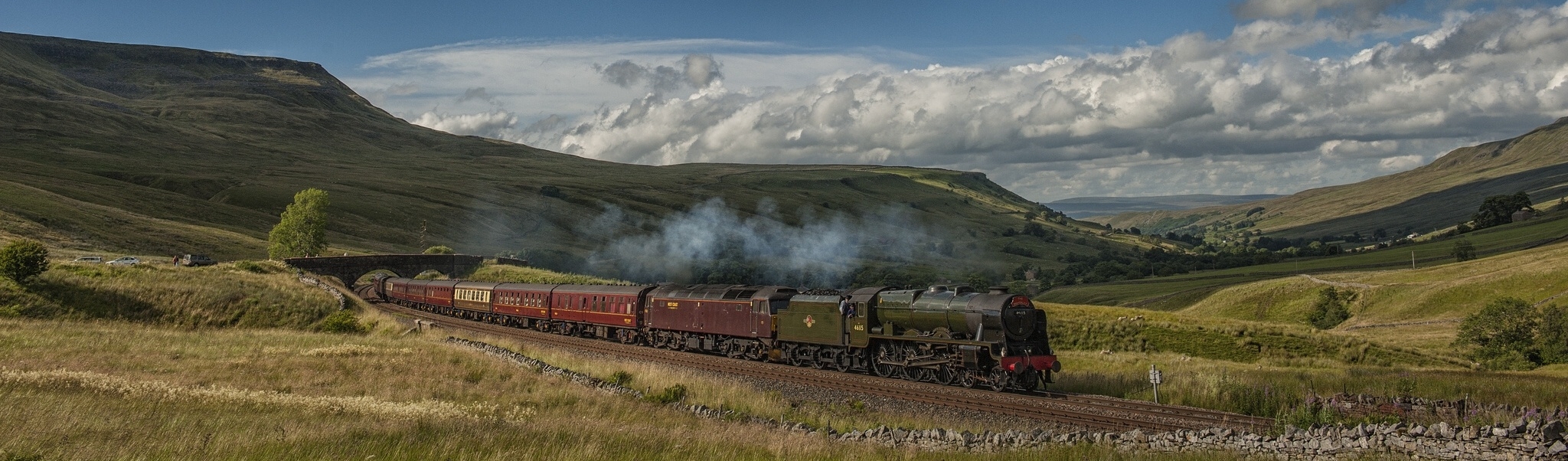



Austrian Southern Railway class 35a
Italian State Railway class 452, Austrian Federal Railways (BBÖ) class 471, and Yugoslav Railway class 132
After the 0-8-0 wheel arrangement had established itself with the class 33 and 34 locomotives on the Semmering, the class 35a was created in 1871. Under the direction of Louis Adolf Gölsdorf, a new locomotive was created that, unlike its predecessors, had an inside frame and outside valve gear.
Since an axle load of 13 tonnes was now permitted, a significant increase in power was possible. With a length of 2,300 mm, the firebox achieved a maximum for its time. Because it was completely behind the last axle and this had lateral play of 20 mm, there was a large overhanging mass. With a top speed of 35 km/h, however, this was of little consequence.
Production comprised 25 locomotives from Wiener Neustadt, 25 from the StEG workshops and five from Floridsdorf in 1871 and 1872. After the Upper Italian SFAI had loaned a locomotive for testing, 60 almost identical locomotives were ordered from Wiener Neustadt. These led to the later FS class 420, which was built by other manufacturers until 1905.
The locomotives of the class 35a were able to pull 210 tonnes on a ramp with a gradient of 2.5 percent. In addition to the Semmering Railway, they were also used on the Brenner Railway and in the Karst Plateau of present-day Slovenia. Like their predecessors, they were later given Kobel chimneys.
After the Second World War, 20 came to the FS and became class 452 there. 23 came to the Kingdom of the Serbs, Croats and Slovenes, of which 16 were later taken over by the JDŽ as class 132. The twelve locomotives remaining in Austria became the class 471 of the BBÖ. The three locomotives remaining in 1938 were numbered by the Reichsbahn as 55 5601 to 5603.
Technical data
General
- Built
- 1871-1872
- Manufacturers
- Wiener Neustadt, StEG, Floridsdorf, Miani, Maffei
- Wheel arrangement
- 0-8-0 (Eight-coupled)
- Gauge
- 1,435 mm (Standard gauge)
Dimensions and weights
- Length loco
- 9.62 m
- Wheelbase
- 3.56 m
- Empty mass
- 45.2 t
- Service mass
- 50.8 t
- Adhesion mass
- 50.8 t
- Rigid wheelbase
- 2.38 m
- Axle load
- 13 t
Boiler
- Grate area
- 2.16 m²
- Firebox surface
- 10.7 m²
- Tube heating surface
- 159.3 m²
- Evaporative heating surface
- 170 m²
- Total heating surface
- 170.0 m²
Power plant
- Driver diameter
- 1,106 mm
- Boiler pressure
- 9 bar
- Expansion type
- simple expansion
- Cylinders
- two, 500 x 610 mm
Power
- Power source
- steam
- Estimated power
- 450 kW (612 PS)
- Top speed
- 35 km/h
- Starting effort
- 105.5 kN
Calculated values
- Factor of adhesion
- 1 : 4.72
- Optimal speed
- 26 km/h
- Power-to-weight ratio
- 8.9 kW/t
- Heating Surface Equivalent
- 223.5 m²
- Cylinder volume/HSE
- 1 : 1,071.80
- Adhesive weight/Total
- 1 : 1.00
- Tractive force/Heating surface
- 1 : 12.96
- Grate area/Heating surface
- 1 : 78.70
- Firebox/Tube surface
- 1 : 14.89