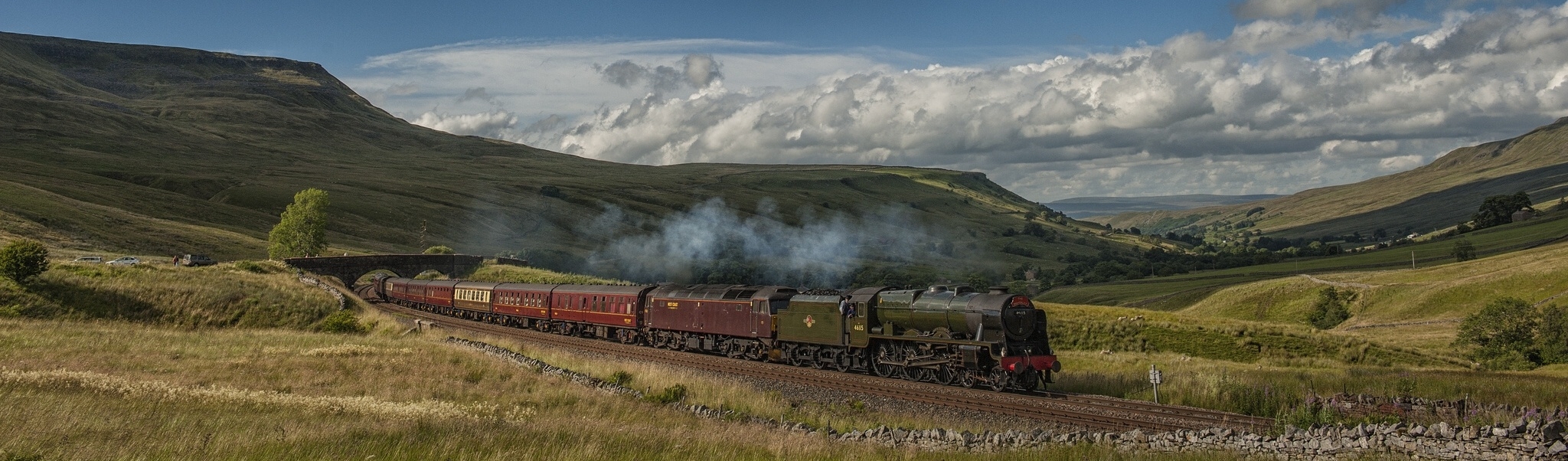



British Rail class 86
originally E3101

The class 86 is a standard locomotive for passenger and freight service that was developed for the West Coast Main Line electrification. It incorporated experiences gained from the classes 81 to 85 of which a total of 100 were built by several manufacturers between 1959 and 1964. In 1965 and 1966, 60 locomotives of the class 86 were built by English Electric at their Vulcan Foundry and 40 by BR at Doncaster. Before the introduction of the TOPS scheme it was designated AL6, what stood for “AC locomotive 6”. Their original numbers were E3101 to E3200.
The class 86 can be distinguished from its predecessors by the rectangular body with only sloped wind screens, while the older ones had sloped noses. Like the classes 83 to 85, it had only one pantograph. The locomotives built by EE had four traction motors of 900 hp each, while the ones built at Doncaster had 1,000 hp each. The traction motors were axle-mounted, what was soon found to damage the tracks at speeds of 100 mph. So the suspension had to be upgraded on many locomotives and the remaining ones were limited to 80 mph for the time being.
In 1970, three were modified for a top speed of 110 mph and the output was increased to 5,000 hp to work as prototypes for the class 87. By the mid-eighties, the remaining locomotives had received upgraded suspension for 100 mph. But at the same time, the sectorisation of British Railways meant that many were now dedicated for freight service only and re-geared for a top speed of 80 mph.
After privatisation, companies like Anglia Railways, Virgin, EWS and Freightliner took over the class 86. Due to the introduction of the class 90 and modern multiple units, regular passenger services ceased in the mid 2000s. The last operator in Britain was Freightliner, which used the class 86 in freight and charter service. The last ones were withdrawn in 2021 and some were subsequently sold to Bulgaria and Hungary. In the UK, three are being preserved in working order.
Technical data
General
| Property | Vulcan Foundry | Doncaster | 86101-86103 |
|---|---|---|---|
| Built | 1965-1966 | 1970 | |
| Manufacturers | English Electric | Doncaster | |
| Wheel arrangement | B-B | ||
| Gauge | 1,435 mm (Standard gauge) | ||
Dimensions and weights
| Property | Vulcan Foundry | Doncaster | 86101-86103 |
|---|---|---|---|
| Length | 17.83 m | ||
| Wheelbase | 13.26 m | ||
| Service mass | 82.3 t | ||
| Adhesion mass | 82.3 t | ||
| Rigid wheelbase | 3.28 m | ||
| Axle load | 22.8 t | ||
Power
| Property | Vulcan Foundry | Doncaster | 86101-86103 |
|---|---|---|---|
| Power source | electric - AC | ||
| Continuous power | 2,685 kW (3,651 PS) | 2,983 kW (4,056 PS) | 3,729 kW (5,070 PS) |
| Top speed | 161 km/h | 177 km/h | |
| Starting effort | 266.9 kN | 258.0 kN | |
Calculated values
| Property | Vulcan Foundry | Doncaster | 86101-86103 |
|---|---|---|---|
| Factor of adhesion | 1 : 3.03 | 1 : 3.13 | |
| Power-to-weight ratio | 32.6 kW/t | 36.2 kW/t | 45.3 kW/t |
| Adhesive weight/Total | 1 : 1.00 | ||