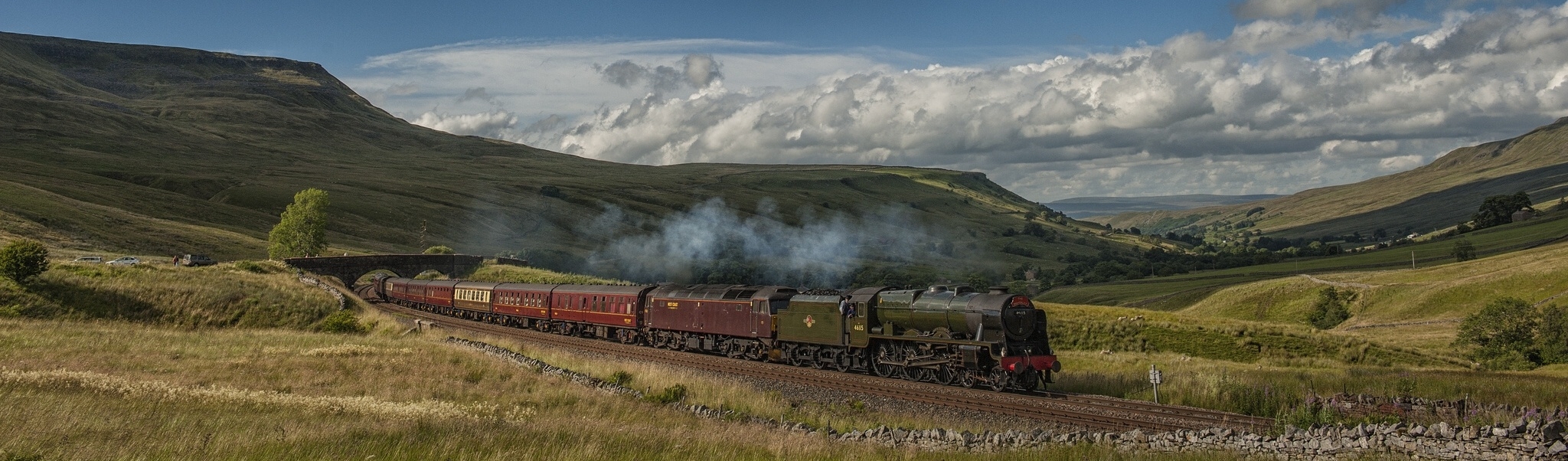



French Northern Railway No. 3.1201 to 3.1290 “Super Pacific”
French State Railway 231 C and D

The name “Super Pacific” describes a total of 90 Pacific locomotives built for the French Nord between 1923 and 1931. They were a direct development of the 3.1151 to 3.1170 series, also being four-cylinder compounds with deep and narrow Belpaire fireboxes and Walschaerts valve gear. The main differences were a driver diameter of 1,900 instead of 2,045 mm, tubes which were one metre longer and a larger superheater. They delivered an output of around 2,800 hp.
The first batch consisted of 40 locomotives which were delivered between 1923 and 1925 and were numbered 3.1201 to 3.1240. They could haul trains heavier than 600 tonnes at 120 km/h and the first ones got tenders which had been sourced from German locomotives which had come as war reparations. Later locomotives of the batch got larger tenders with a water capacity of 34 instead of 31 cubic metres. In the thirties, these locomotives were fitted with ACFI feed water heaters, smoke deflectors and Lemaître blast pipes.
A second batch of only eight locomotives was delivered in 1930 and numbered 3.1241 to 3.1248. They could be recognized by a second steam dome and had an ACFI feed water heater from the start. Their tenders now had a capacity of 37 cubic metres. A third batch of 40 was delivered in 1930 and 1931 and was numbered 3.1251 to 3.1290. The main difference were the piston valves which were better suited for high-speed operation.
Already in 1929, two prototypes with the numbers 3.1249 and 3.1250 had been delivered. The first one had Caprotti valve gear and the second one had Dabeg valve gear. As early as in 1932, both were rebuilt to simple expansion with Cossard valve gear. This was also no success and so both were scrapped in 1946.
When the SNCF was founded in 1938, the standard locomotives became 231 C 1 to 88 and the two prototypes became 231 D 1 and 2. After World War II, more powerful express locomotives like the 231 E Pacifics designed by Chapelon took over the most important trains on the northern territory. So most 231 C were used in commuter service after World War II, while others were withdrawn. The last ones were gone by 1962 and today, only 3.1200 (ex 231 C 78 and 3.1280) is preserved.
Technical data
General
| Property | 3.1201-3.1240 | 3.1241-3.1248 | 3.1251-3.1290 |
|---|---|---|---|
| Built | 1923-1925 | 1930 | 1930-1931 |
| Manufacturers | Blanc-Misseron, SFCM | SFCM | |
| Wheel arrangement | 4-6-2 (Pacific) | ||
| Gauge | 1,435 mm (Standard gauge) | ||
Dimensions and weights
| Property | 3.1201-3.1240 | 3.1241-3.1248 | 3.1251-3.1290 |
|---|---|---|---|
| Length loco | 12.53 m | ||
| Wheelbase | 10.42 m | ||
| Service mass | 99.2 t | 100.4 t | 100.5 t |
| Adhesion mass | 56.3 t | 57.1 t | 56.8 t |
| Rigid wheelbase | 4.02 m | ||
| Water capacity | 34,000 l | 37,000 l | |
| Fuel capacity | 9 t (coal) | ||
Boiler
| Property | 3.1201-3.1240 | 3.1241-3.1248 | 3.1251-3.1290 |
|---|---|---|---|
| Grate area | 3.54 m² | ||
| Firebox surface | 15.7 m² | ||
| Tube heating surface | 188.5 m² | ||
| Evaporative heating surface | 204.2 m² | ||
| Superheater surface | 63.8 m² | ||
| Total heating surface | 268.0 m² | ||
Power plant
| Property | 3.1201-3.1240 | 3.1241-3.1248 | 3.1251-3.1290 |
|---|---|---|---|
| Driver diameter | 1,900 mm | ||
| Boiler pressure | 17 bar | ||
| Expansion type | compound | ||
| Cylinders | four, HP: 440 x 660 mm and LP: 620 x 690 mm | ||
Power
| Property | 3.1201-3.1240 | 3.1241-3.1248 | 3.1251-3.1290 |
|---|---|---|---|
| Power source | steam | ||
| Indicated power | 2,059 kW (2,799 PS) | ||
| Top speed | 130 km/h | ||
| Starting effort | 131.2 kN | ||
| Starting effort simple | 157.4 kN | ||
Calculated values
| Property | 3.1201-3.1240 | 3.1241-3.1248 | 3.1251-3.1290 |
|---|---|---|---|
| Factor of adhesion | 1 : 4.21 | 1 : 4.27 | 1 : 4.25 |
| Optimal speed | 97 km/h | ||
| Power-to-weight ratio | 20.8 kW/t | 20.5 kW/t | |
| Heating Surface Equivalent | 410.3 m² | ||
| Cylinder volume/HSE | 1 : 996.89 | 1 : 996.90 | 1 : 996.89 |
| Adhesive weight/Total | 1 : 1.76 | 1 : 1.77 | |
| Tractive force/Heating surface | 1 : 10.22 | ||
| Grate area/Heating surface | 1 : 75.71 | ||
| Firebox/Tube surface | 1 : 12.01 | ||
| Total/Superheater | 1 : 3.20 | ||