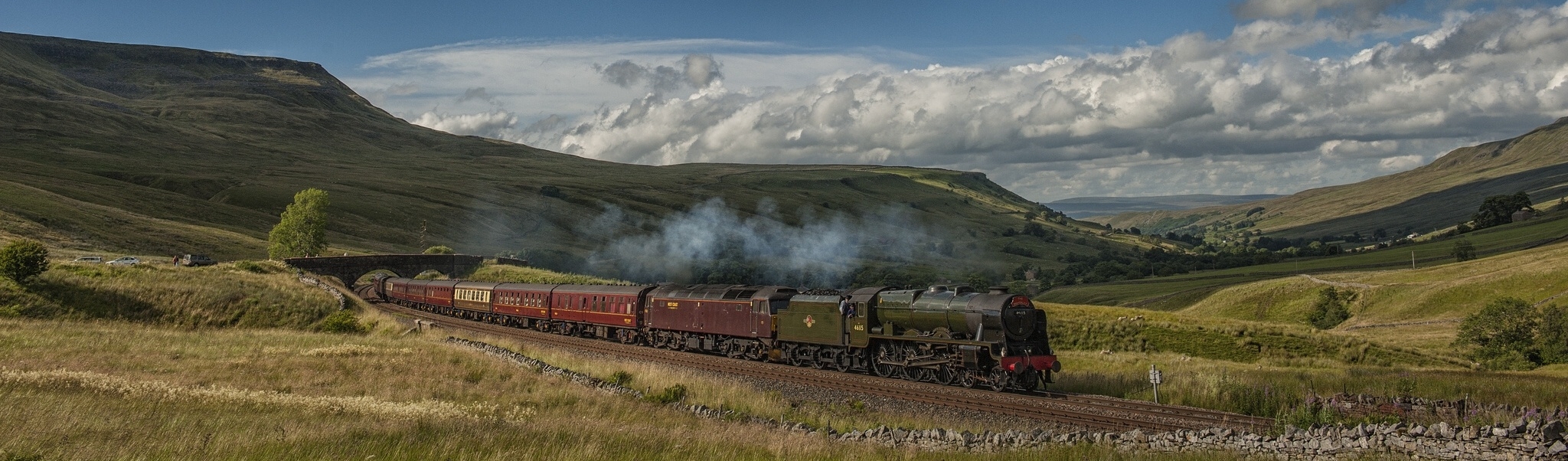
Since at the beginning of the 1920s the Atlantic express locomotives of the Great Northern Railway could no longer cope with the increasing train weights, Sir Nigel Gresley began to develop a Pacific locomotive. The first attempt to expand the Atlantics with another coupled axle was quickly dropped. Gresley eventually took inspiration from the Pennsylvania Railroad's K4 and developed a locomotive that just barely fit into the gauge and weight limits.
From the American locomotive he took over the large firebox, which was mounted above the trailing axle, a roof of the firebox that sloped towards the rear and a boiler that tapered towards the front. What was new was the introduction of a combustion chamber, which at the same time limited the length of the smoke tubes to a tolerable level. There were three cylinders, all acting on the second coupled axle. The inner cylinder and its connection rod were inclined by about seven degrees to keep it out of the way of the first driving axle. Furthermore, Gresley's valve gear was used, which did not require any control mechanism on the inside and instead transmitted the valve movements of the outer cylinders to the inner cylinder via a lever mechanism.
The first two with the numbers 1470 and 1471 were completed in 1922 and formed the basis for the production locomotives. These were not completed until after the 1923 grouping and were given the class designation A1 by the LNER. Although they were actually developed for the GNR, they were used throughout the LNER network. The locomotives that were to cover longer distances were given a four-axle tender. The locomotives for the Flying Scotsman were given new types of corridor tenders, which allowed passage to the train. In order to facilitate the long non-stop runs, various improvements were made to some locomotives, which were mainly in the area of valve gear. Soon the boiler pressure was also increased from 180 to 220 psi. One of these locomotives was the first to achieve a proven speed in excess of 100 mph as the 1904 record of GWR 3700 No. 3440 “City of Truro” is not confirmed with certainty. Later, they even reached 108 mph.
Based on the subsequently introduced improvements, the improved A3 was built from 1928. It also had a boiler pressure of 220 psi, optimized valve gear and lubrication, better weight distribution, and slightly smaller cylinders with a higher degree of superheating. The driver's seat was moved from right to left to allow a better view of the trackside signals. The conversion of the existing class A1 locomotives soon began, but this took until 1949. This resulted in a total of 51 rebuilt A1 and 27 newly built A3. In 1945, Gresley's successor, Thompson, significantly modified an A1 into a one-off A1/1.
Around 1960, the locomotives, which were still almost complete, were modernized further. This included a double Kylchap exhaust system and various types of smoke deflectors. This should allow them keep to the same timetables as diesel locomotives, but their number thinned out noticeably from 1962 and the last one was withdrawn in 1966. Today, the A3 4472 “Flying Scotsman” is the only one preserved. After undergoing a major overhaul between 2006 and 2016, it is back in service and bears the BR number 60103, which it received in 1948.