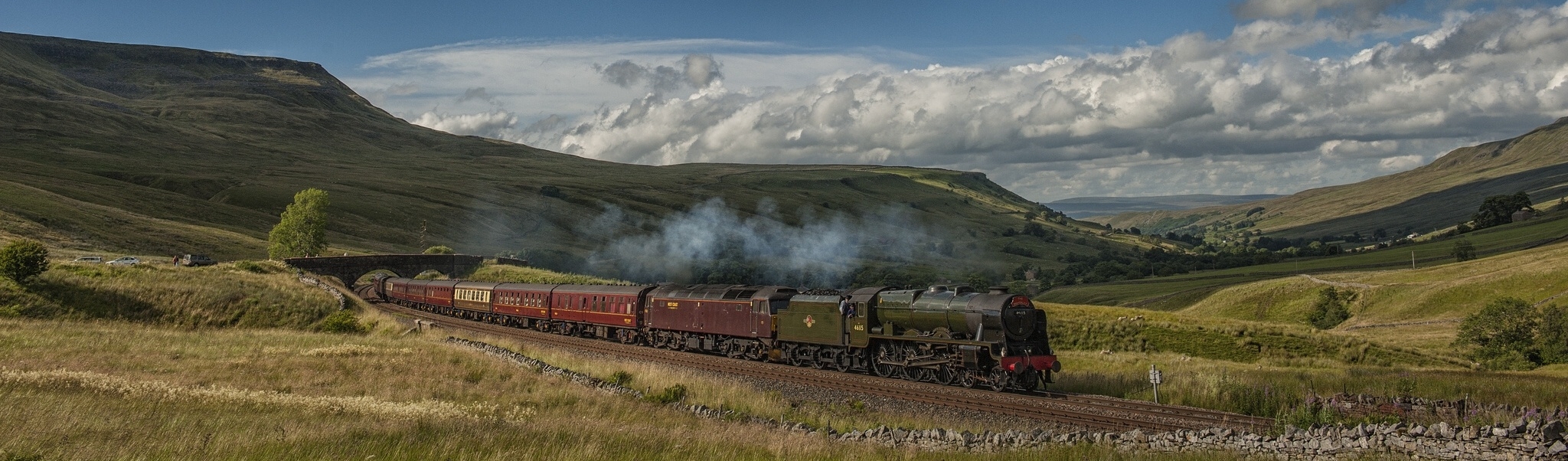



Hejaz Railway No. 210, 211, 213 and 215
Since the Hejaz railway from Damascus to Medina also had steep gradients and tight curves, a powerful locomotive was needed for freight trains. The tracks were also light with a gauge of just 1,050 mm, and so six axles were needed to achieve the necessary power. Due to the lack of water along the line, the tender had to be big enough. The order went to Henschel of Kassel, where four Mallets were built to meet these requirements.
The six axles were distributed over two chassis groups, the first of which had only two coupled axles and one leading axle. The first coupled axle could also be moved laterally to improve running characteristics in curves. Additionally, the two chassis groups were coupled to each other, which is not usual with Mallets. The locomotives apparently met the requirements and easily hauled 250-tonne trains over the entire line.
Technical data
General
- Built
- 1907
- Manufacturers
- Henschel
- Wheel arrangement
- 2-4-6-0
- Gauge
- 1,050 mm
Dimensions and weights
- Wheelbase
- 8.53 m
- Service mass
- 52.4 t
- Adhesion mass
- 45.8 t
- Total mass
- 90.8 t
- Water capacity
- 18,000 l
- Fuel capacity
- 5 t (coal)
Boiler
- Grate area
- 2.5 m²
- Firebox surface
- 10 m²
- Tube heating surface
- 154 m²
- Evaporative heating surface
- 164 m²
- Total heating surface
- 164.0 m²
Power plant
- Driver diameter
- 1,080 mm
- Boiler pressure
- 12 bar
- Expansion type
- compound
- Cylinders
- four, HP: 320 x 560 mm and LP: 510 x 560 mm
Power
- Power source
- steam
- Estimated power
- 600 kW (816 PS)
- Starting effort
- 77.7 kN
- Starting effort simple
- 93.3 kN
Calculated values
- Factor of adhesion
- 1 : 5.78
- Optimal speed
- 47 km/h
- Power-to-weight ratio
- 11.4 kW/t
- Heating Surface Equivalent
- 214.0 m²
- Cylinder volume/HSE
- 1 : 955.48
- Adhesive weight/Total
- 1 : 1.15
- Tractive force/Heating surface
- 1 : 9.90
- Grate area/Heating surface
- 1 : 65.60
- Firebox/Tube surface
- 1 : 15.40