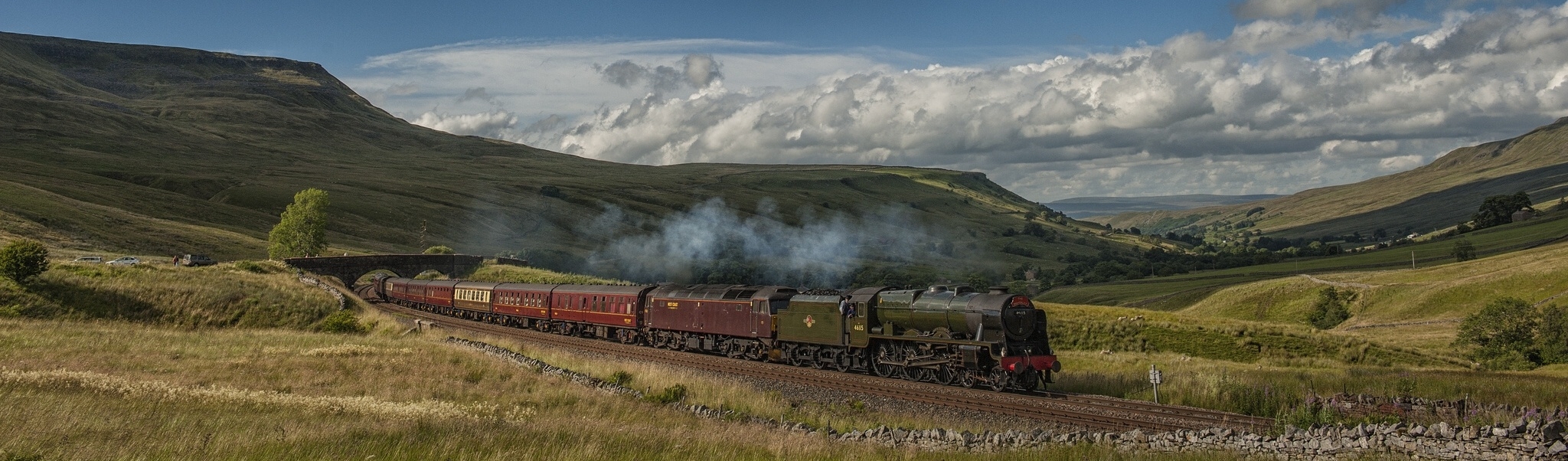



German Reichsbahn VT 137 standard railcar
German Reichsbahn class 185

In the years 1934 and 1935, the Reichsbahn procured three subtypes of so-called standard railcars, which were almost identical in appearance and technical equipment and differed primarily in terms of the layout of the interior. The 52 examples that were built made it possible for the first time to convert passenger and express trains almost completely to railcars on a larger route network.
Common features of these vehicles were a length of almost 22 meters, rounded front sides and a diesel-electric propulsion system with engines from Maybach or MAN, mostly with 400 hp. The first six pieces reached 100 km/h, all others 110 km/h. Thanks to lightweight construction with welded car bodies, the weight could be kept at around 50 tonnes. With this power-to-weight ratio, good acceleration could also be achieved with the unpowered driving trailer that was usually carried along. In some cases, trailers were also purchased and the motor cars were also designed for multiple working in order to be able to form trains of different lengths depending on the number of passengers.
The first variant to be built consisted of 20 vehicles, the structure of which was referred to as the “Essen floor plan”. They were created for traffic in West German conurbations and were designed for a quick change of passengers. In addition, they received double sliding doors in the middle and one single door on each side at the outer ends of the passenger compartment. The engine room was located behind one of the driver's cabs. Their running numbers were 137 031 to 035, 137 074 and 137 080 to 093.
This was followed by 20 examples with an express car layout, which did not have the middle doors and were intended for longer distances with fewer stops. They were used in the Ruhr rapid transit and in a large central German network. The latter was concentrated around Halle, Leipzig and Dresden, but also extended as far as Kassel, Braunschweig and what is now Poland and the Czech Republic. The vehicles were designated 137 058 to 067 and 137 075 to 079.
The third design consisted of 17 railcars with a standard floor plan. To ensure a higher passenger flow, they had a large storage space next to the middle double door. Apart from luggage, this was intended for passengers who wanted to get off again after a short time and were thus able to remain standing in this area. The company numbers were 137 094 to 110 and they were also used in the central German network.
After the war, in which some examples were converted into mobile emergency generators, 15 vehicles remained with the Bundesbahn and 24 with the Reichsbahn. Some of the Bundesbahn received new turbocharged engines and three were equipped with a hydrodynamic transmission. Their decommissioning was completed by the mid-sixties. At the Reichsbahn, up to five-part sets were formed. In the case of combinations of two motor cars and three trailers, it was sometimes necessary for a locomotive to push the train uphill. Some examples were redesignated as class 185 in 1970. The last ones were retired in 1978.
Technical data
General
| Property | Maybach | MAN | Mercedes-Benz |
|---|---|---|---|
| Built | 1934-1935 | ||
| Manufacturers | Westwaggon, Wismar, MAN, DÜWAG, Talbot | ||
| Wheel arrangement | 2-B | ||
| Gauge | 1,435 mm (Standard gauge) | ||
Dimensions and weights
| Property | Maybach | MAN | Mercedes-Benz |
|---|---|---|---|
| Length | 21.87 m | ||
| Wheelbase | 17.47 m | 17.52 m | |
| Empty mass | 47.4 t | 48.1 t | 45.1 t |
| Service mass | 51.6 t | 52.3 t | 49.5 t |
| Rigid wheelbase | 3.50 m | ||
Power plant
| Property | Maybach | MAN | Mercedes-Benz |
|---|---|---|---|
| Engine | Maybach GO 5 | MAN L2x6V 17,5/18 | Mercedes-Benz OM 86 |
| Engine type | V12 diesel | twin-6-cyl. diesel | V12 diesel |
Power
| Property | Maybach | MAN | Mercedes-Benz |
|---|---|---|---|
| Power source | diesel-electric | ||
| Indicated power | 302 kW (411 PS) | 309 kW (420 PS) | 331 kW (450 PS) |
| Top speed | 90 km/h | 110 km/h | 90 km/h |
Calculated values
| Property | Maybach | MAN | Mercedes-Benz |
|---|---|---|---|
| Power-to-weight ratio | 5.9 kW/t | 6.7 kW/t | |