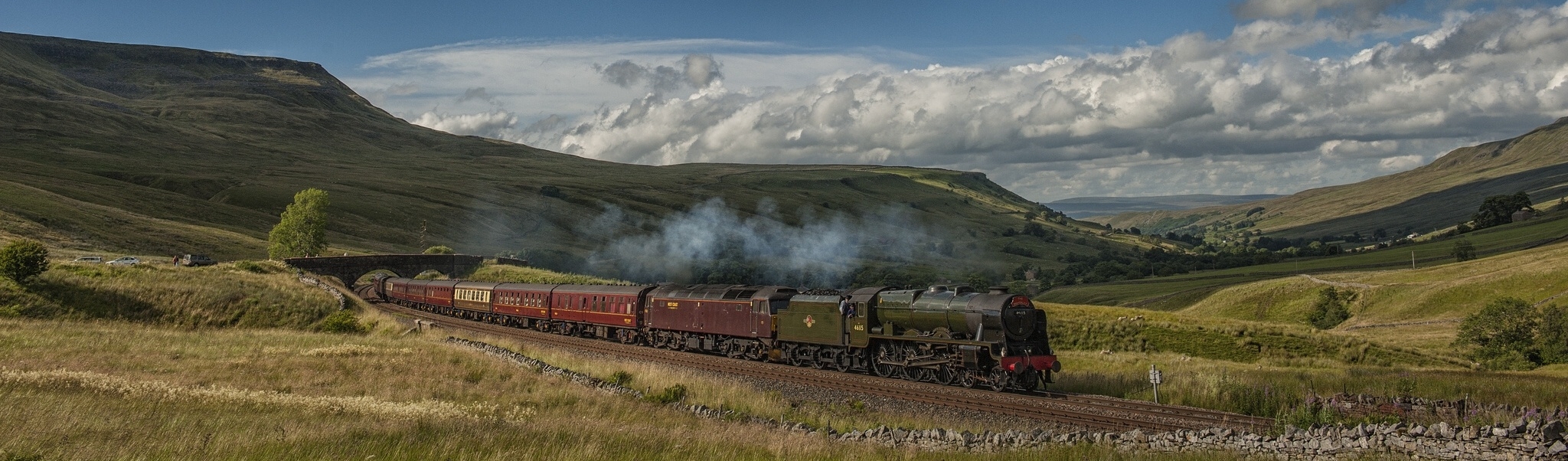
After the end of series production of the T 16, the T 161 was introduced, which was a heavier derivative of this one. In the period between 1913 and 1924, a total of 1,236 were manufactured, which was a multiple of the predecessor.
Although the T 161 nominally did not have a higher indicated power than the T 16, the development focus was on a more massive construction in order to increase the adhesive weight. So they hardly differed from each other on the outside, except for a slightly longer length, but by using a frame with greater plate thickness, more generously dimensioned braking devices and larger supplies, the service weight had increased by a few tonnes.
Since the third axle was now driven instead of the fourth, an axle arrangement was used that deviated from the standard form of the Gölsdorf system. In this case, the first and fourth axles were designed with a lateral play of 50 mm and the wheel flanges of the driven axles were made thinner. The top speed originally remained at the same level as the previous class at 40 km/h, but later the chassis was subsequently standardized on many locomotives, what thus permitted speeds of up to 60 km/h. In principle, it was possible to haul up to 1,800 tonnes at 40 km/h on the flat, but these locomotives, like the T 16, were mainly used on mountain lines and for shunting. Up to 600 tonnes at 25 km/h were possible on a gradient of one percent, or a maximum of 280 tonnes at only 20 km/h with a gradient of 2.5 percent.
Although by far the largest part of the production went directly to Prussia, some were also ordered by the Reichseisenbahn Alsace-Lorraine or by smaller railways. The Reichsbahn took over 1,117, which were numbered 94 502 to 94 1740. As with other locomotives, some of the T 161 which had been operating abroad were later returned to the Reichsbahn. This happened around 1935 with the locomotives from the Saarland or during the war with others from the annexed Poland. The locomotives later came to both German railway administrations, where they were in service until 1974. Due to their large number, several locomotives are still existing today, but none of them are operational.