


Tender Locomotives 0-4-2 “Olomana”
UIC Classiification B1

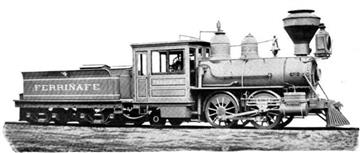
The wheel arrangement 0-4-2 refers to a steam locomotive with two coupled axles and one trailing axle. The name “Olomana” used in North America came from a small narrow-gauge tank locomotive in Hawaii that Baldwin built in 1883. In different countries, this wheel arrangement is referred to as follows:
Olomana
UIC: B1
Whyte: 0-4-2
Switzerland: 2/3
France: 021
Turkey: 23
The 0-4-2 was developed in parallel to the 2-4-0. Here, too, the primary concern was to obtain a four-coupled locomotive with an additional carrying axle for better guidance on the track. Although the trailing axle improved the guidance, it was not as good as with a leading axle. However, the running characteristics were still convincing, especially with inside cylinders that did not protrude far beyond the first coupled axle. There was also the advantage that deep fireboxes could be accommodated without any problems.
The first known locomotives with this wheel arrangement date from 1834 and were built by Robert Stephenson & Co. for hauling freight trains on the Stanhope and Tyne Railway. The first locomotive to be built entirely in Germany, the “Saxonia” of the Leipzig-Dresden railway from 1838, was also a 0-4-2. In Austria, the “Minotaur” and “Ajax” imported from England in 1841 joined them.
In Great Britain in particular, this design became popular in the period that followed and was mainly used for goods trains. Thus the 1838 Liverpool & Manchester Railway's “Lion” could already haul 200 tons, but was also capable of speeds of up to 45 mph or 72 km/h. Over time, models with larger wheels were introduced, which were used equally with goods and passenger trains.
While tender locomotives with a 0-4-2 wheel arrangement soon disappeared from other countries, they were widespread in Great Britain until the 1860s. Soon they were mainly only built as small tank locomotives. A few British railway companies were the exception in that they continued to procure tender locomotives with this wheel arrangement in the decades that followed. In addition to the Caledonian, the GS&WR and the LSWR, it was the LB&SCR that put B1 class express locomotives into service until 1891.
Locomotives
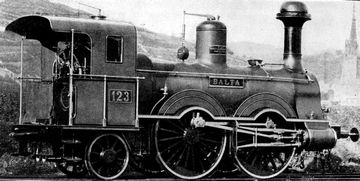
Galician Carl Ludwig Railway I
Austria-Hungary
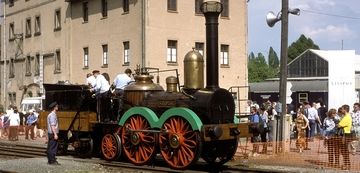
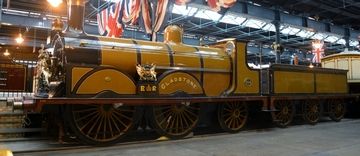
London, Brighton & South Coast class B1 “Gladstone”
Great Britain
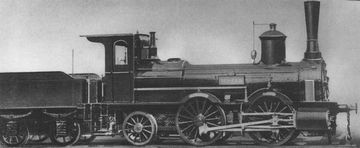
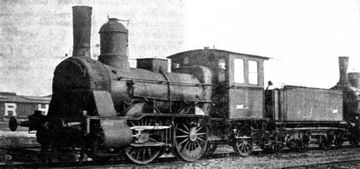
Prussian G 2
Germany
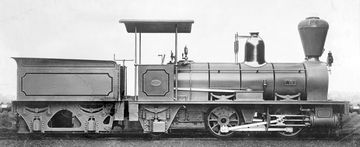
Queensland Railways class A10
Australia