


Tender Locomotives 4-10-0 “Mastodon” and 4-10-2 “Reid Ten-wheeler”
UIC Classification 2'E and 2'E1'
The wheel arrangements 4-10-0 and 4-10-2 designate steam locomotives with a two-axle leading bogie and five coupled axles, with the latter additionally having one trailing axle. In different countries, these wheel arrangements are referred to as follows:
Mastodon / Southern Pacific
UIC: 2'E / 2'E1'
Whyte: 4-10-0 / 4-10-2
Switzerland: 5/7 / 5/8
France: 250 / 251
Turkey: 57 / 58
Both wheel arrangements were very rare attempts to combine five coupled axles with the good guidance at higher speeds provided by a two-axle leading bogie. In theory, this promised a combination of the high adhesive weight and tractive effort of locomotives such as the 2-10-0 and 2-10-2 with better running characteristics. In practice, however, the long coupled wheelbase and the resulting overall dimensions limited the advantages of these types.
The 4-10-0 was the simpler of the two arrangements. Without a trailing axle, the firebox had to be placed above or between the rear coupled wheels, limiting its possible dimensions. Only very few locomotives were built with this arrangement. The name “Mastodon” was sometimes applied to it, although this name had originally been associated with an early 4-8-0 locomotive and never became firmly established for the 4-10-0.
The 4-10-2 was somewhat more successful. The additional trailing axle allowed for a larger firebox and made it better suited for sustained high outputs. In North America, the type became particularly associated with the Southern Pacific, which introduced three-cylinder locomotives of this wheel arrangement in the 1920s. As a result, “Southern Pacific” became the common American name for the 4-10-2. Other examples were operated by the Union Pacific, which called its locomotives of this type “Overlands”.
Despite their considerable power, 4-10-2 locomotives remained uncommon. Five coupled axles resulted in a long and relatively rigid running gear, while the two-axle leading bogie and trailing axle made the entire locomotive very long. At the same time, articulated locomotives could provide similar or greater adhesive weight while negotiating tighter curves. For many applications, 4-8-4 locomotives also offered sufficient power with better suitability for higher speeds.
As a result, neither the 4-10-0 nor the 4-10-2 became a standard wheel arrangement. The few 4-10-2 classes built in North America represented an interesting intermediate step between conventional rigid-frame locomotives and the increasingly powerful articulated types. Outside North America, both arrangements remained exceptional.
Locomotives
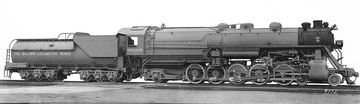
Baldwin No. 60000
United States
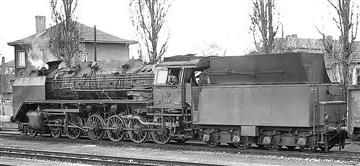
Bulgarian State Railway class 11
Bulgaria
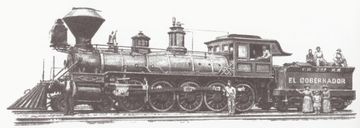
Central Pacific “El Gobernador”
United States
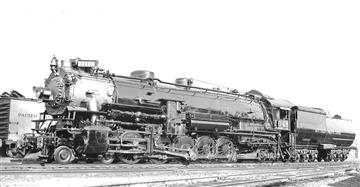
Southern Pacific classes SP-1 to SP-3
United States