


Tender Locomotives with six or seven coupled axles
Locomotives with six or even seven coupled axles in a single frame were extremely rare. They were usually created when very high adhesive weight was required, but axle loads were limited or articulated locomotives were considered undesirable. While five coupled axles could still be accommodated in a conventional frame with reasonable effort, adding further axles created considerable technical challenges.
The main problem was the enormous coupled wheelbase. A locomotive with six or seven driving axles mounted rigidly in one frame would hardly have been able to negotiate ordinary curves without causing excessive forces on the wheels and rails. For this reason, these locomotives required special measures to make their running gear flexible. Individual axles were given considerable lateral play, some wheels had reduced or no flanges and, in some cases, the coupling rods also required special joints to accommodate the movements of the axles.
Six coupled axles were nevertheless used successfully in a few cases. The Austrian class 100 of 1911 demonstrated that a 2-12-0 could negotiate the tight curves of a mountain railway by combining several laterally movable axles with a flangeless driving axle. This concept was later adopted for the Württemberg class K, of which 44 were built and which proved successful on steep and winding routes. In France, André Chapelon rebuilt a 2-10-0 into the unique 2-12-0 No. 160 A 1 to obtain more adhesive weight for a locomotive optimized for enormous power at low speeds.
A different approach was taken in the United States. The Union Pacific class 9000 had a 4-12-2 wheel arrangement and combined six coupled axles with a two-axle leading bogie and a trailing axle. A total of 88 were built, making them by far the most numerous locomotives with six coupled axles in a single frame. They were designed to combine very high tractive effort with better running characteristics at speed than the articulated freight locomotives of their time.
Seven coupled axles represented an even greater extreme. The only notable example was the Soviet AA 20 of 1934 with a 4-14-4 wheel arrangement. Despite lateral movement of the outer driving axles, three pairs of flangeless wheels and flexible coupling rods, its running gear still caused damage to the track. Only one was built, demonstrating the practical limits of accommodating such a large number of coupled axles in a single frame.
In general, locomotives with six or seven coupled axles remained technical curiosities. Although some designs were successful in their intended roles, the complicated running gear largely offset the theoretical advantages of their high adhesive weight. Articulated locomotives provided a much more practical way to distribute the weight over a large number of driving axles while retaining sufficient flexibility in curves. Higher permissible axle loads also made it possible to achieve similar or greater power with only four or five coupled axles. For these reasons, locomotives with six or seven coupled axles in a single frame never became widespread.
Locomotives
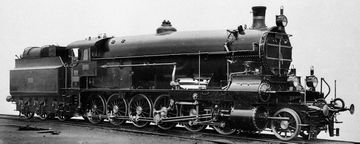
Imperial-Royal State Railways class 100
Austria-Hungary
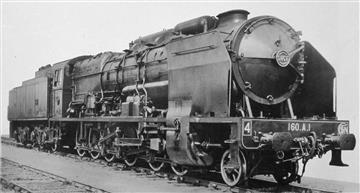
French State Railway 160 A
France
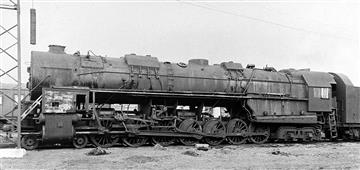
Soviet Railways series AA 20
Soviet Union
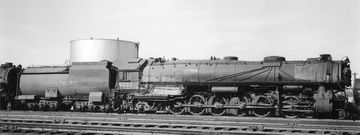
Union Pacific class 9000
United States
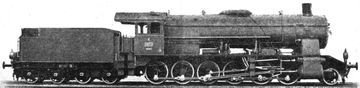
Württemberg K
Germany