


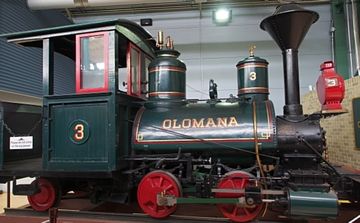
Tank Locomotives 0-4-2T “Olomana”
UIC Classification B1 and B1'
The wheel arrangement 0-4-2T refers to a tank locomotive with two coupled axles and one trailing axle. The name “Olomana” used in North America came from a small narrow-gauge tank locomotive in Hawaii. In different countries, this wheel arrangement is referred to as follows:
Olomana
UIC: B1 t
Whyte: 0-4-2T
Switzerland: E 2/3
France: 021 T
Turkey: 23
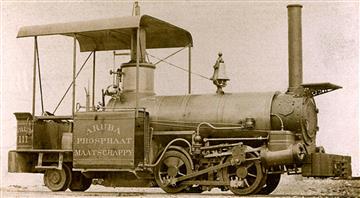
A 0-4-2T tank locomotive can generally be seen as an 0-4-0T with an additional trailing axle. This not only leads to better running characteristics, it also allows to store more supplies in the back of the locomotive. As seen in the example of the small narrow gauge “Olomana”, the trailing axle is also a good means to support a cab that is very large in comparison to the rest of the locomotive. Additionally, the small trailing wheels allowed to mount the cab in a low position to better fit into a small loading gauge. On other small locomotives like “Willem III” of Aruba Phospate, the trailing axle carried a heavy firebox with dome and safety valves that was mounted completely behind the driving wheels.
In Britain, where tank locomotives were wide-spread, 0-4-2 tender locomotives were only ordered by a few companies after the 1860s. But still many tank locomotives were ordered with this wheel arrangement by many companies. Among their primary tasks were suburban trains or light passenger trains on secondary lines. Possibly the last standard gauge 0-4-2T in Britain was the GWR class 4800, later class 1400, designed for light push-pull trains.
Several other countries used 0-4-2T tank locomotives for their main gauge, i.e. standard, broad or Cape gauge, although they were mainly used for light trains on branch lines. Among these were Finland, New Zealand and South Africa. In Indonesia there were rack locomotives with this wheel arrangement and in New Zealand, there were the class H Fell locomotives for the Rimutaka incline.
Elsewhere, these locomotives were often used on narrow gauge lines or by contractors or industrial and logging companies. Among these was “Olomana”, the locomotive that gave this wheel arrangment its name. It was a small saddle tank that was built by Baldwin in 1883 for the Waimanalo Sugar Co. and was used on sugar cane plantations.

Locomotives
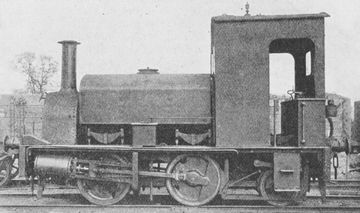
Isle of Wight Central No. 3 “Mill Hill”
Great Britain
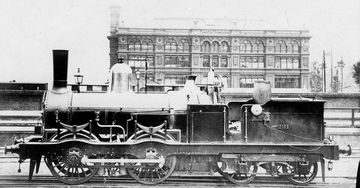
London, Brighton & South Coast Craven South London Tanks
Great Britain
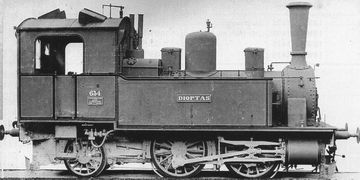
Saxon IIIb T
Germany
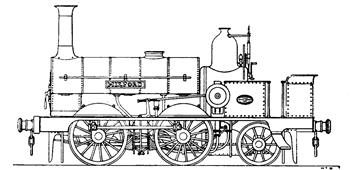
Cambrian Railways No. 3 “Milford”
Great Britain
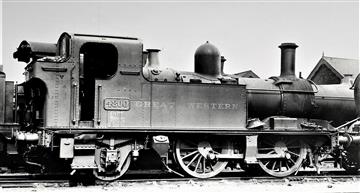
Great Western Railway classes 4800 and 5800
Great Britain
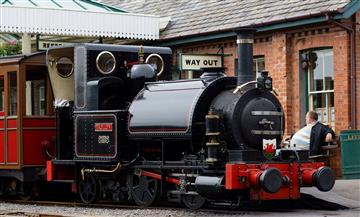
Talyllyn Railway No. 1 “Talyllyn”
Great Britain
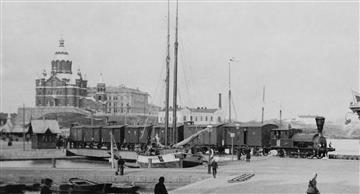
Finnish Railway class B1
Finland
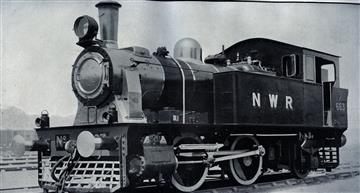
Indian Railways class XT
India