


Tank Locomotives 0-12-0T, 2-12-0T and 2-12-4T
UIC Classification F, 1'F and 1'F2

Even if tank locomotives with articulated chassis were built in many places in order to achieve high tractive forces, there were a number of reasons against this. These were primarily the tendency of one group of drivers to slip and the need for flexible steam lines. As a result, tank locomotives with six coupled axles in one frame were created in some places. However, since this places high demands on the construction of the running gear in order to be able to negotiate curves without problems, only very few locomotives of this type were built.
The following wheel arrangements have been implemented: 0-12-0T or F (six driving axles and no carrying axles), 2-12-0T or 1'F (one leading axle and six driving axles), 2-12-2T or 1'F1' (one leading axle, six driving axles and one trailing axle) and 2-12-4T or 1'F2' (one leading axle, six driving axles and two trailing axles).
The first twelve-coupled tank locomotives were built in 1912. One of them was the kkStB class 269 for the Erzbergbahn in Styria. This rack locomotive had no carrying axles. At the same time, Hanomag built the class F10 tank locomotives, with a leading and a trailing axle each, for the Staatsspoorwegen in the Dutch East Indies. The Bulgarian State Railways procured two different types of twelve-coupled tank locomotives for their heavy ore trains. These were the 1922 series 4000 without carrying axles and the 1931 series 4500. These had a leading axle and a bogie to carry the rear supplies. One much earlier 0-12-0T locomotive that was not directly designed as a tank locomotive was the “Pennsylvania” of the Philadelphia & Reading. It was built as a pusher in 1863 and got small water tanks to make the way up and down the grade after being fired up.
Locomotives
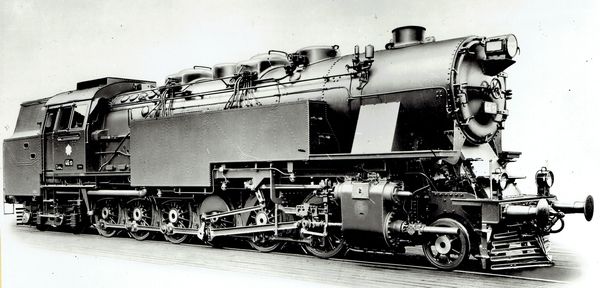
Bulgarian State Railway series 4500
Bulgaria

Staatsspoorwegen class 800
Indonesia
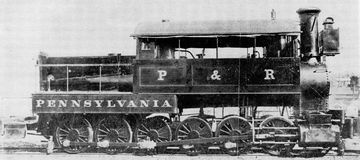
Philadelphia & Reading “Pennsylvania”
United States