


East German Electric Locomotives from 1945 to 1993

Compared to the Federal Republic, the GDR had a much more difficult start after the war when converting from steam to electric traction. Although the area in what is now Saxony and Saxony-Anhalt, previously referred to as “Central Germany”, was one of the first electrified regions in Germany from 1910, it suffered greatly from the war reparations. The overhead lines and many tracks were dismantled and taken to the Soviet Union. All functioning electric locomotives also had to be handed in. The construction of overhead lines and electric locomotives could not yet be tackled, since many modern industrial plants had also been handed over to the Soviet Union.
From 1952 the locomotives and railcars were returned to the GDR, but in a very poor condition. It was 1955 by the time the first vehicles were refurbished and the first lines re-electrified. Now the development of new electric locomotives could begin. However, it was not until 1961 that the first newly developed E 11 type electric locomotive was completed. Until the mid-1970s, the three types E 11, E 42 and E 251 remained the only ones, of which a total of 403 were built.
The E 251 represents a special case here, as it was developed for the Rübelandbahn in the Harz Mountains. While the system with 15,000 V and 16⅔ Hz, which was already in use before the war, was used to re-electrify the GDR, the industry was unable to supply suitable converters for the line that was electrified as a stand-alone system. So they stuck with the 50 Hertz from the national power grid and the line was operated with 25,000 volts. For this purpose, 15 six-axle E 251 were built, which also had to overcome a gradient of six percent.
Depending on the availability of raw materials and the capacity of the industry, further electrification in the GDR was temporarily slowed down or accelerated again. The new generation of East German electric locomotives appeared in 1974 with the class 250. The class 243 that followed in the 1980s introduced a new type of electronic power and speed control. A maximum speed of 160 km/h was planned for both, but was then reduced due to the condition of the line network.
After reunification, these locomotives came to all of Germany because they were more modern than most of the standard electric locomotives of the Bundesbahn and there was an urgent need for more locomotives. The former class 243 and its derivatives were still in use on the S-Bahn in former Eastern and Western Germany after 2020, but are now almost exclusively used by private operators.

Locomotives

German Reichsbahn E 11
Germany
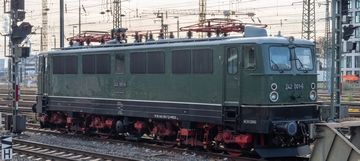
German Reichsbahn E 42
Germany

German Reichsbahn E 251
Germany
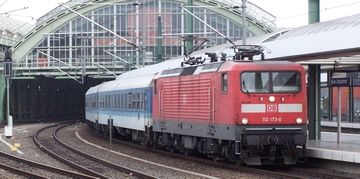
German Reichsbahn class 212
Germany

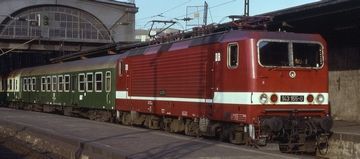
German Reichsbahn class 243
Germany
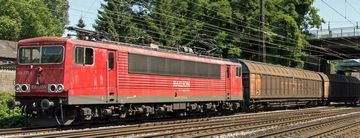
German Reichsbahn class 250
Germany
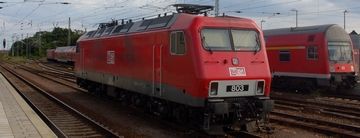
German Reichsbahn class 252
Germany